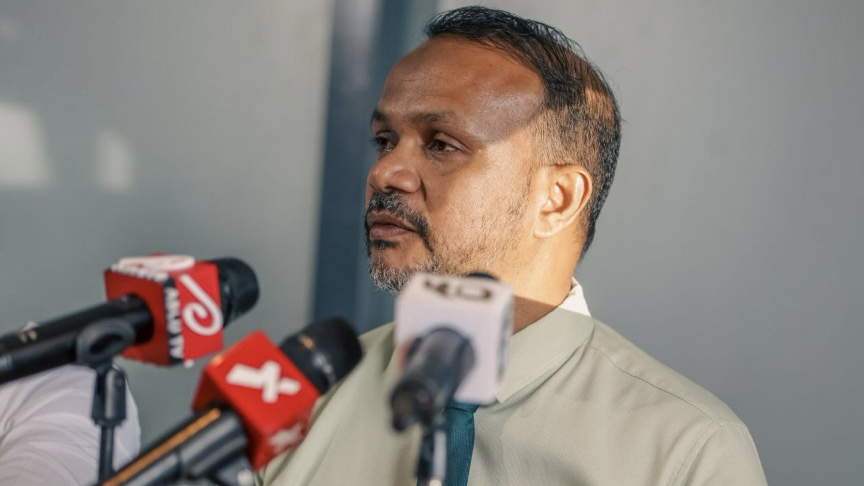


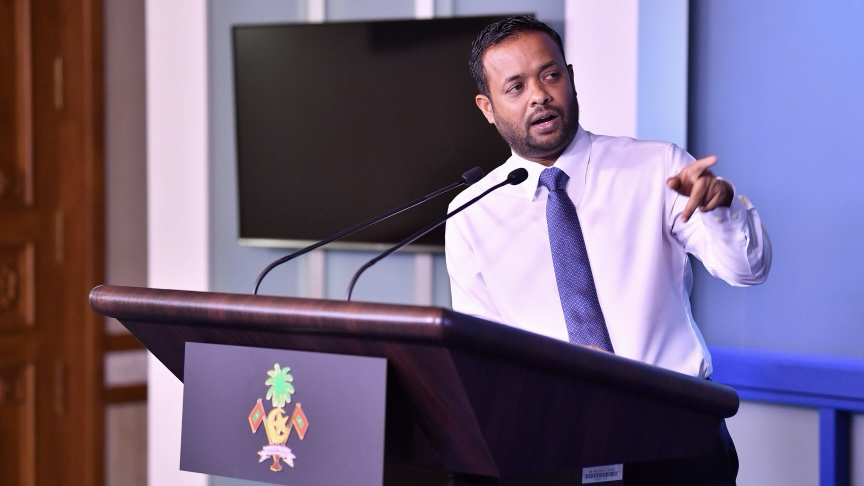
Housing Minister Dr. Abdulla Muthalib has announced plans to introduce safeguards barring Israeli nationals and Israeli-controlled entities from owning property at Rasmale’, amid public concerns over the proposed USD 20 billion Maldives Waterfront and Marina Project.
In a LinkedIn post on Monday, Muthalib said the government would strengthen existing protections to ensure that Israelis cannot acquire property in the planned development, directly or indirectly.
The minister said public apprehension surrounding the project was largely driven not by its valuation or lease terms, but by fears that Rasmale’ could become a foothold for Zionist settlement.
However, he described these fears as unfounded, arguing that Israeli settlements have historically expanded into territories seized and held through military force, rather than through foreigners purchasing holiday homes or leasehold properties in sovereign countries.
“There is no reported case anywhere such a takeover happening through foreigners buying holiday homes or leasehold property in a sovereign country that controls its own borders, visas and land,” Muthalib said.
He accused those promoting such fears of exploiting the Palestinian struggle and Maldivians’ solidarity with Palestine for domestic political gain.
“Palestinians deserve our solidarity, not to be used as a prop in our domestic politics,” he said.
The Maldives has prohibited entry on Israeli passports since April 2025. However, Muthalib noted that some Israeli nationals hold dual citizenship and could potentially enter the country using another passport, making it difficult for immigration authorities to identify them at the border.
He said property ownership checks would provide an additional layer of protection against this loophole.
Under the proposed safeguards, Israeli nationals and Israeli-controlled entities would be prohibited from participating in property ownership at Rasmale’ as buyers, beneficial owners, shareholders, financiers or sales agents.
All buyers and beneficial owners would be required to declare every nationality they currently hold or have previously held. Muthalib said false declarations would result in the lease being voided, the property reverting to the state and the purchase price potentially being forfeited.
The screening process would also be repeated whenever a property changes hands.
Muthalib said investors could qualify for the corporate residence visa introduced in 2015, subject to the same eligibility requirements applicable to other qualifying businesses. All applications would remain subject to the Israeli passport ban and nationality screening.
He stressed that purchasing property would not grant permanent residency or citizenship, even to eligible foreign buyers. Caps would also be introduced to limit the share of units that could be held by any individual or nationality.
“The land stays ours. Only approved buyers could hold a lease, and every buyer would pay for it. No buyer would have the option to renew lease and hold a property in perpetuity. There would be no freehold,” he said.
The government also intends to give Maldivians the first right to purchase a share of the units in every phase of the development, with payments made in Maldivian rufiyaa. Ownership caps imposed on foreign buyers would not apply to Maldivians, he added.
The proposed development came into focus on September 21, when Abu Dhabi-based real estate developer Eagle Hills signed a commercial terms agreement, or letter of intent, for the USD 20 billion project.
The planned destination is expected to include international hotels and resorts, premium and branded residences, a marina, waterfront promenades, restaurants, retail outlets, and leisure and wellness facilities.
In an exclusive interview with Sun on Thursday, Eagle Hills founder and chairman Mohamed Alabbar said the company would fully comply with Maldivian laws and that the project would offer numerous benefits to local businesses.
Muthalib said the Maldives could maintain its firm position against Israel’s conduct and continue supporting Palestine while pursuing national development without compromising its principles.
“In fact, building our own economy is how we protect that stance. A Maldives that can pay its own way does not have to choose between providing for its people and standing by its principles,” he said.