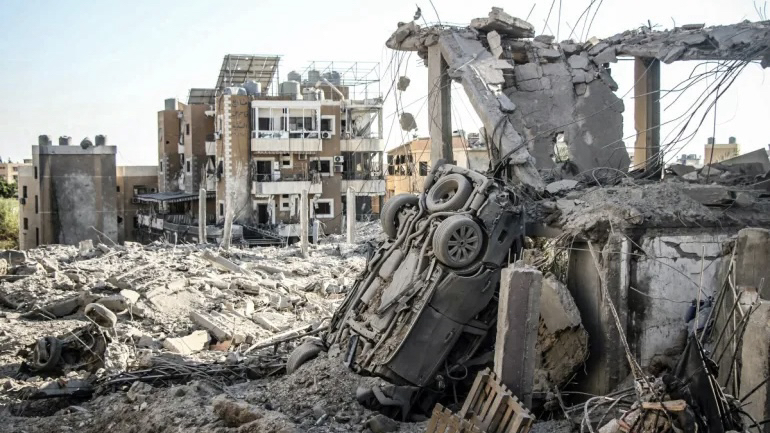


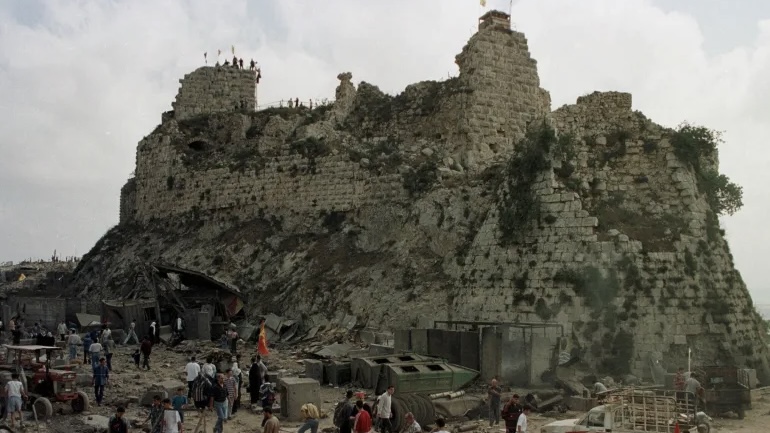
BEIRUT, Lebanon — Israeli military operations in southern Lebanon have caused significant damage to ancient landmarks, historic towns, and religious sites, according to Lebanese Culture Minister Ghassan Salame, who warned that the full scale of destruction remains unclear due to continued Israeli military presence in parts of the region.
Speaking after a ceasefire came into effect, Salame said Lebanese authorities have been unable to conduct complete assessments in several affected areas because Israeli forces continue to occupy a strip of territory extending roughly 10 kilometres into southern Lebanon.
“We cannot work under the shadow of occupation. There are villages that have been completely bulldozed,” Salame said.
Among the locations affected is the historic Beaufort Castle, a medieval fortress that overlooks southern Lebanon and has long been considered one of the country’s most significant heritage landmarks. The occupied zone also contains centuries-old villages inhabited by Christian, Sunni Muslim, and Shia Muslim communities, along with churches, mosques, and other cultural sites.
Beyond the occupied areas, extensive air strikes have struck ancient towns including Tyre and Nabatieh. Concerns have also been raised about potential damage to the Crusader-era fortress in the town of Tebnin following heavy bombardment.
Salame stressed that Lebanon’s cultural heritage extends far beyond its famous archaeological ruins.
“Heritage is not only Roman and Phoenician antiquities. Heritage is also historic buildings, archaeological sites and buildings with a cultural function,” he said.
The damage comes after nearly four months of intense Israeli air and ground operations across southern Lebanon, leaving many communities struggling to assess losses to both infrastructure and cultural landmarks.
Meanwhile, the Israeli military announced that one of its soldiers was killed during operations in southern Lebanon overnight.
The soldier was identified as Captain David Hazutt, 21, a platoon commander in the Golani Brigade’s 12th Battalion from Ashkelon. According to the Israeli army, another soldier was lightly wounded in the same incident and was transported to hospital for treatment.
The circumstances surrounding the clash were not immediately disclosed.
The latest casualty highlights the continuing volatility along the Israel-Lebanon frontier despite the ceasefire agreement. While hostilities have decreased, tensions remain high, and concerns persist over the security situation as well as the humanitarian and cultural impact of the conflict.
As residents begin returning to their homes and villages, many are finding widespread destruction and uncertainty about what can be rebuilt. Lebanese officials say assessing the damage to the country’s cultural heritage will be a long process, particularly in areas that remain inaccessible.
The conflict has not only claimed lives and displaced communities but has also placed some of Lebanon’s most treasured historical sites at risk, raising concerns about the preservation of a heritage that spans thousands of years.