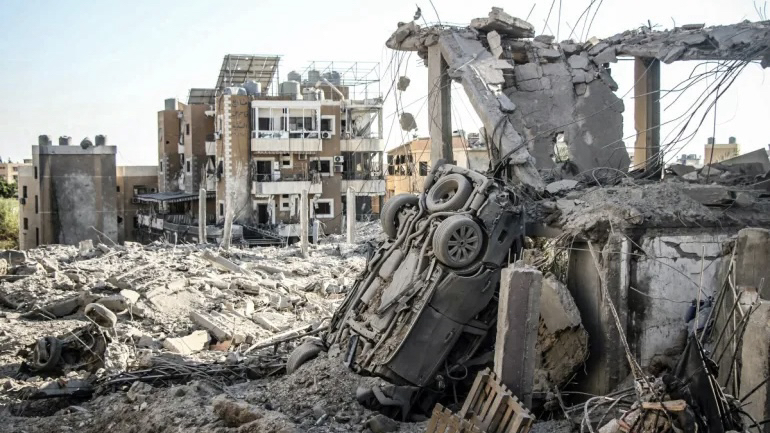



The United States has carried out a series of airstrikes against Iranian military facilities following an incident involving a commercial cargo vessel transiting the Strait of Hormuz, further escalating tensions between Washington and Tehran.
According to the US Central Command (CENTCOM), the strikes targeted missile production facilities, drone storage sites, and several air-defense radar systems along Iran’s southern coastline. American officials described the operation as a response to what they called an Iranian drone attack on the Singapore-flagged cargo ship Eva Lovely earlier this week.
US President Donald Trump condemned the reported attack on the vessel, accusing Iran of violating recent understandings aimed at reducing tensions in the region. Speaking to reporters at the White House, Trump warned that any further attacks would be met with a strong response from the United States.
Vice President J.D. Vance also criticized Tehran’s actions, saying disputes could be addressed through communication rather than military escalation. He warned that continued aggression would provoke further consequences.
Iran, however, rejected the US narrative and accused Washington of undermining diplomatic efforts. Ebrahim Azizi, head of the Iranian Parliament’s National Security and Foreign Policy Commission, said the strikes demonstrated that the United States was not committed to negotiations or ceasefire arrangements.
“The United States once again attacked Iran during a period of dialogue,” Azizi said in remarks posted on social media. He argued that the latest military action would ultimately lead to “retreat and regret” for Washington.
Meanwhile, Iran’s Islamic Revolutionary Guard Corps (IRGC) claimed that its naval forces had targeted American military positions across the region in response to the US attacks.
Iranian authorities also disputed reports of significant damage from the American operation. State-linked media quoted local port officials in Hormozgan Province as saying that Sirik Port, one of the locations reportedly targeted, remained fully operational and suffered no damage to infrastructure or equipment despite explosions being reported nearby.
The latest confrontation comes amid ongoing tensions surrounding shipping routes through the Strait of Hormuz, one of the world’s most important energy corridors. Since late February, concerns over maritime security in the region have disrupted trade and contributed to volatility in global oil markets.
Washington and Tehran had previously agreed on June 17 to a 60-day arrangement intended to reduce hostilities and ensure safe passage for international shipping through the waterway. However, allegations that Iran continued collecting fees from commercial vessels and recent attacks on shipping have strained the agreement.
The deteriorating security situation has also affected international maritime operations. Efforts by the International Maritime Organization (IMO) to assist and protect more than 11,000 seafarers operating in the region have reportedly been disrupted as tensions continue to rise.
With both sides exchanging accusations and military responses, fears are growing that the latest developments could trigger a broader confrontation in the Gulf, threatening regional stability and global trade.