



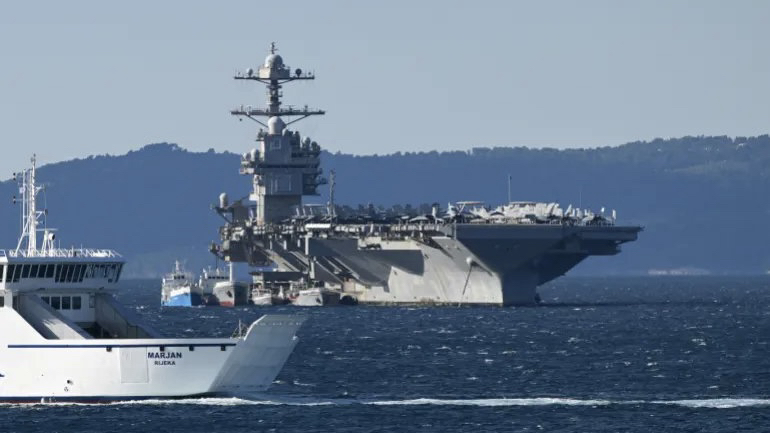
The United States’ largest aircraft carrier, the USS Gerald R. Ford, suffered extensive damage in a fire while supporting military operations against Iran earlier this year, according to newly released footage and accounts from sailors aboard the vessel.
The USS Gerald R. Ford, a $13 billion nuclear-powered aircraft carrier and the largest warship in the world, was operating in the Red Sea during the conflict involving the United States, Israel and Iran when the fire broke out in March.
At the time, the US Navy said the fire had been contained, two sailors had received treatment for non-life-threatening injuries, and the carrier remained fully operational. However, newly obtained video released by CNN shows the damage was far more severe than initially disclosed.
Footage from inside the vessel shows sleeping quarters completely destroyed by the blaze. Metal bunk beds were reduced to twisted, charred frames, while ceilings were burned and partially hollowed out. Exposed electrical wiring hung from above and ashes covered parts of the deck.
“I seriously thought we were going to lose the ship,” one sailor aboard the carrier told CNN. “It’s either fight or die.”
According to the sailor and a senior US official familiar with the incident, the carrier’s fire-suppression system failed to operate as intended, forcing crew members to battle the fire manually.
The crew reportedly spent around 30 hours extinguishing the blaze, cleaning affected areas and preventing the fire from reigniting. Approximately 600 sailors lost access to their sleeping quarters as a result of the damage.
A senior US official told CNN that the Navy’s initial public statements understated the impact of the incident. The fire temporarily affected the carrier’s operational capabilities, with the ship unable to launch combat sorties for two days. The vessel later sailed to Greece for temporary repairs before returning to operations.
Chief of Naval Operations Admiral Daryl Caudle praised the crew’s response, describing the incident as a significant fire caused by laundry and dryer equipment.
“The crew handled that so well, and they fought it brilliantly and courageously,” Caudle said.
The Ford played a central role in US military operations against Iran, launching multiple air strikes against Iranian targets. During the deployment, the carrier strike group also faced what officials described as persistent threats from Iranian missiles and one-way attack drones.
One sailor recalled seeing Iranian munitions appearing on the horizon while the ship was operating in the Red Sea. According to the sailor, alerts would sound whenever incoming threats approached within a certain distance, prompting crew members to prepare for possible impacts and damage-control operations.

The fire was not the only challenge faced during the deployment. Sailors also reported repeated failures of the ship’s toilet systems, forcing crew members to walk across the vessel in search of functioning facilities.
Military analysts said the incident highlights both the vulnerabilities and resilience of modern warships. Maritime strategist Hunter Stires noted that fire and flooding remain among the greatest threats to any vessel at sea, adding that the Ford’s survival was a testament to the crew’s training and preparedness.
Commissioned in 2017, the USS Gerald R. Ford is the newest and most technologically advanced aircraft carrier in the US Navy. The vessel completed an 11-month deployment earlier this year, the longest operational deployment by a US aircraft carrier since the Vietnam War.
The carrier returned to its home port in Norfolk, Virginia, in May and is expected to undergo extensive maintenance and repairs. One US official told CNN that it could be at least a year before the warship is fully ready for deployment again.
The exact cause of the fire remains under investigation.




One thought on “America’s Largest Aircraft Carrier Suffers Major Fire Damage from ongoing Iran War”