



Malé — The Maldives is best known internationally for its luxury resorts, turquoise waters and millions of foreign visitors. But a new investigation by The Wall Street Journal has placed the country at the centre of a very different international trade route, one allegedly moving restricted Western technology to Russia.
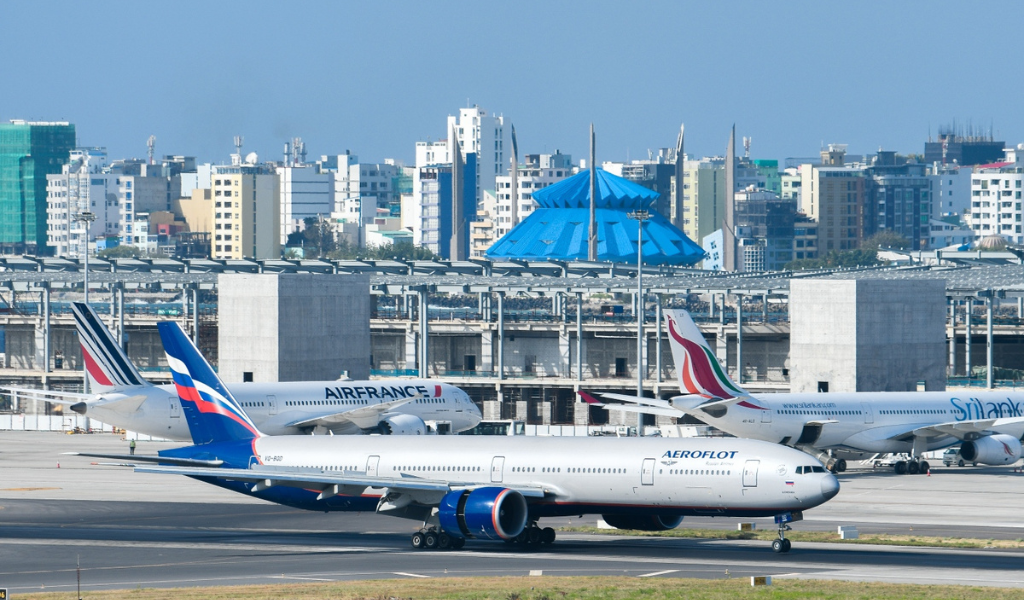
According to the investigation, hundreds of millions of dollars worth of goods subject to Western export restrictions have passed through Velana International Airport in Malé before being flown onward to Moscow.
The shipments reportedly include microchips, aircraft components, optical equipment and high-strength aerospace parts, products that can have legitimate civilian uses but can also be used in military and advanced technological systems.
The investigation, published on September 2, found that goods originating from the United States, Europe and China can arrive in Malé, remain within the airport’s transit system and later leave aboard Russian carrier Aeroflot for Moscow.
The Maldives, therefore, may not be the final destination for the goods. Instead, the country is alleged to be functioning as a logistical bridge between international suppliers and Russia.
From the Maldives to Moscow
The route described by the Journal is relatively straightforward.
Goods are initially shipped by suppliers in the United States, Europe or China, sometimes with buyers or destinations in third countries listed on the original documentation.
After arriving at Velana International Airport, the cargo can remain within the airport’s transit area rather than formally entering the Maldivian market.
According to documents reviewed by the Journal, local intermediaries then assist in transferring the cargo onto Aeroflot flights travelling from Malé to Moscow.
In some cases, shipping documents are reportedly changed during the process, obscuring the original supplier or changing the listed recipient.
Once in Russia, some of the goods are allegedly distributed to companies that have been sanctioned by Western governments.
Among those identified in the investigation are entities connected to S7 Airlines, one of Russia’s largest airlines, whose aircraft maintenance operations have faced difficulties obtaining replacement components because of Western sanctions.
The goods reportedly include microchips that can be used in sophisticated guidance systems, optical equipment used in satellite-related applications and aerospace fasteners that can be used in aircraft and other advanced systems.
A $630 million mystery
Perhaps the most striking element of the investigation is the enormous discrepancy between Russian and Maldivian trade statistics.
Russian trade data analysed by Import Genius show imports attributed to the Maldives rising from less than $7 million in 2021 to more than $630 million in 2022.
That was the year Russia launched its full-scale invasion of Ukraine and Western governments imposed sweeping sanctions and export controls on Moscow.
The figure subsequently declined, but Russia still recorded approximately $160 million in imports from the Maldives in 2024, according to the data cited by the Journal.
The numbers become particularly unusual when compared with Maldivian records.
Maldives Customs data reportedly show that between 2022 and 2025, the Maldives exported only around $2,300 worth of goods to Russia, largely tuna along with approximately $25 worth of leaflets and brochures.
The difference suggests that the vast majority of the Russian trade attributed to the Maldives was not goods produced in the country.
Instead, the figures appear consistent with cargo being recorded by Russian authorities as originating from, or passing through, the Maldives.
Import Genius research director William George also warned that the Russian figures may actually understate the scale of the trade, after Russian authorities began restricting access to trade data.
The airport connection
The investigation comes as cargo traffic through Velana International Airport continues to grow.
In July, Maldives Airports Company Limited reported that the airport handled a record 126 tonnes of freight in a single day.
State broadcaster PSM News reported that Aeroflot accounted for approximately 12 percent of outbound freight during the first half of 2026.
The airport’s growing cargo business has also become economically significant.
The Wall Street Journal reported that Maldives Airports Company Limited recorded a record profit in 2024, making it the country’s most profitable state-owned company.
The increase in cargo traffic therefore comes with an economic benefit for the airport and businesses involved in logistics and freight handling.
But it also raises questions about whether the country’s transit system is sufficiently equipped to identify cargo that may be subject to international export controls.
Local companies under scrutiny
The Journal identified several Maldivian companies in documents associated with the shipments.
One is Freight Care, whose managing director, Hussain Waheed, acknowledged that the company handles goods transiting through Malé to Russia.
Waheed denied knowingly helping transport goods that could be used to manufacture weapons.
“We do not support any war,” he told the Journal.
Another company identified was Go Investment.
The Journal reported that an address listed for the company led to a small electronics shop in Malé and that several other companies were registered at the same address.
The people and companies identified by the Journal have not been established as knowingly participating in sanctions violations merely by appearing in shipping or corporate documents.
That distinction is important.
The investigation describes a network through which goods allegedly move, but being involved in the handling or transit of cargo does not by itself establish that a company knowingly violated sanctions or export-control laws.
What do Maldivian authorities say?
The Wall Street Journal reported that it contacted the Maldivian government and Maldives Airports Company Limited for comment but did not receive a response.
The Journal also reported that Western officials believe Maldivian authorities are aware of the issue and are facing increasing pressure from the United States and European governments to close the route.
However, no public U.S. government statement specifically demanding that the Maldives shut down the alleged route has been identified.
That distinction matters.
The United States has extensive sanctions and export controls aimed at preventing Russia from obtaining advanced technology through third countries. The U.S. Treasury has also previously sanctioned individuals and companies involved in supplying Russia’s military-industrial base.
But the current reporting does not establish a publicly issued U.S. ultimatum to the Maldives over the specific Malé–Moscow route.
The absence of a public statement does not necessarily mean that private diplomatic discussions have not taken place.
Not the first warning
The apparent trade route also does not appear to be entirely new.
Questions surrounding the Maldives’ role in Russian trade emerged several years ago, particularly over semiconductor shipments.
Earlier reporting had already highlighted the discrepancy between Russian trade records and Maldivian statistics and pointed to the role of transshipment, cargo passing through the Maldives without becoming part of the country’s domestic trade.
The latest Wall Street Journal investigation appears to provide a much broader picture, alleging that the same geographic advantage that makes Malé an attractive international transit point can also make it useful for companies attempting to move restricted goods toward Russia.
Why the Maldives?
The Maldives has several characteristics that make Malé attractive as a transit point.
It is geographically positioned along major international air routes, possesses an international airport with growing cargo operations and maintains direct air links with Russia.
Russia is also one of the Maldives’ most important tourism markets, creating a significant economic relationship between the two countries.
That relationship makes the issue particularly sensitive.
For Moscow, the route could provide another channel through which Western restrictions can be bypassed.
For Malé, however, the same activity raises the risk of becoming associated with Russia’s sanctions-evasion networks, potentially exposing Maldivian companies and financial institutions to greater scrutiny from Western governments.
A gateway, not necessarily a source
The most important point emerging from the investigation is that calling the Maldives an exporter of hundreds of millions of dollars worth of technology to Russia would be misleading.
The Maldivian economy does not manufacture the sophisticated aircraft components, microchips and optical systems described in the investigation.
Rather, the allegation is that Malé is being used as a gateway.
Goods produced elsewhere allegedly arrive at Velana International Airport, are transferred through the airport’s cargo system and then continue to Moscow.
That makes the Maldives less a source of Russian technology than a potential link in the supply chain through which Russia obtains technology from elsewhere.
The scale of the Russian trade figures, however, raises questions that Maldivian authorities may now have to answer.
How much restricted cargo is passing through Velana?
Who is handling it?
How thoroughly is transit cargo inspected?
Which Maldivian companies are involved?
And, most importantly, what measures are being taken to ensure that the Maldives does not become a convenient route around international sanctions?
For now, the answers remain unclear.
But the Wall Street Journal investigation has placed a new spotlight on Malé not as a destination for tourists, but as a potential gateway in a global supply chain stretching from Western technology manufacturers to Moscow.