




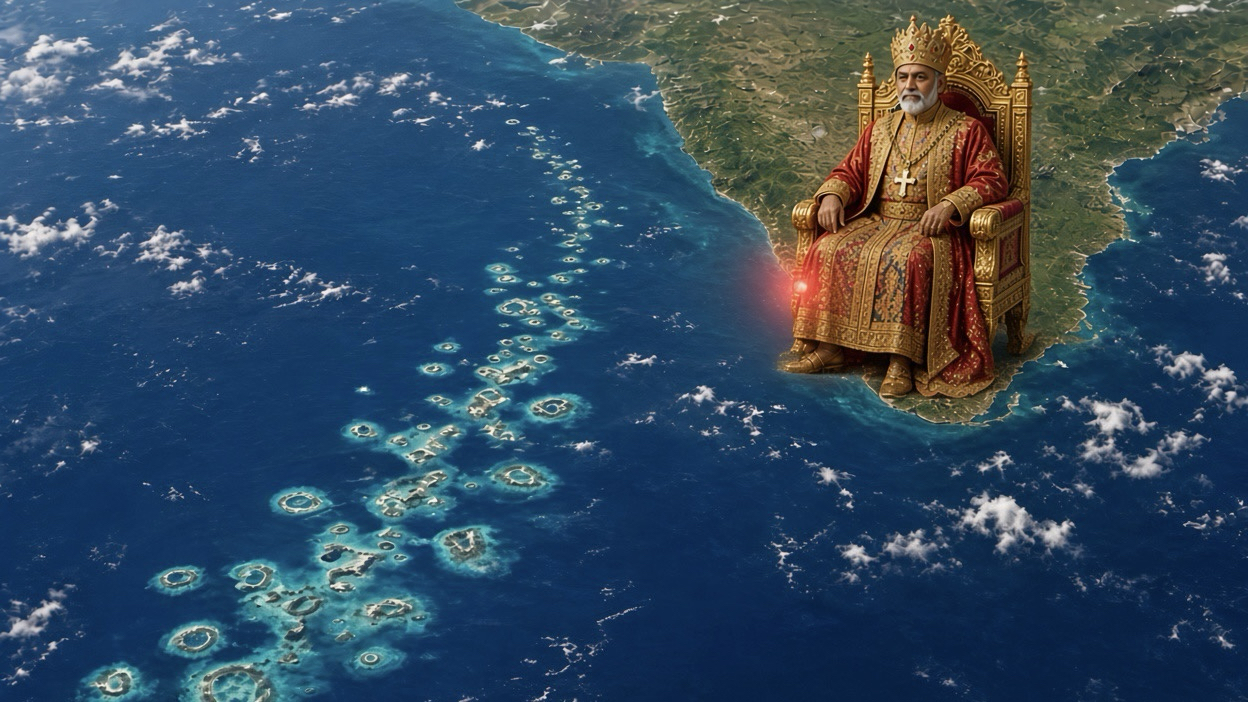
King Dom João, was King of the Maldives from 1583 to 1603. A member of the Hilaalee dynasty and the son of King Dom Manoel, João inherited the Maldivian crown at a time when the monarchy existed in an unusual and increasingly complicated state.
Although he was recognized as the successor to Dom Manoel, João remained in Portuguese Goa throughout his reign and never returned to Malé to exercise personal rule. The government of the Maldives was instead conducted by regents and powerful local rulers, most notably Muhammad Thakurufaanu, His Brother and later, His Son.
Early life
Dom João was the son of Dom Manoel, formerly Sultan Hassan IX of the Maldives. Manoel had converted to Christianity and taken the Portuguese name Dom Manoel before eventually establishing himself in Goa under Portuguese protection.
João grew up within this Portuguese environment. The surviving royal chronologies do not provide a reliable birth date or detailed account of his childhood, so little can be said with certainty about his early years.
His life was nevertheless closely connected to the Portuguese world. Unlike the Muslim rulers who had governed the Maldives before his family, João belonged to a Christian royal household established in Goa.
Accession to the Maldivian throne
His father Dom Manoel died.
His death transferred the dynastic claim to his son, Dom João. João therefore became King of the Maldives, inheriting the position his father had held while remaining in Goa.
João’s accession, however, did not mean that a new king arrived in Malé.
The political arrangement established during Dom Manoel’s later reign had already separated the royal claim from the actual administration of the country. Dom Manoel had remained in Goa while Kateeb Mohamed Thakurufaanu of Utheemu and his brother Hassan Thakurufaanu acted as his co-regents in the Maldives.
Consequently, when Manoel died, João inherited a throne that he could claim but could not personally occupy.
He became a king in absentia.
The succession crisis of 1583
The death of Dom Manoel created a complicated political situation in Malé.
According to the traditional royal chronology, Kateeb Mohamed Thakurufaanu assumed the title of Sultan following Manoel’s death. This represented a departure from the arrangement under which he and his brother had acted as regents for Dom Manoel. The same tradition describes this assumption of the sultanate as contrary to the earlier treaty and therefore not legally binding within the dynastic framework that recognized Dom João.
This created a distinction between the dynastic claim of Dom João and the actual political authority exercised in Malé.
Even though João was the king claimed by the dynasty in Goa, Mohamed Thakurufaanu was in the Maldives and had already established himself as one of the country’s most powerful political figures.
The situation was therefore not a straightforward transfer of power from one king to another.
Instead, the Maldives entered a period in which the person regarded as the king and the person exercising effective authority were increasingly different individuals.
Sultan Ibrahim Kalaafaan
The situation changed again in 1585, when Kateeb Mohamed Thakurufaanu died.
His son, Ibrahim Kalaafaan, inherited the political position of his father. Ibrahim became the dominant ruler in the Maldives and is described in the surviving royal chronology as the de facto Sultan, while legally serving as the regent of the kings who remained in Goa.
A king who never returned to Malé
The unusual nature of João’s reign is therefore one of its defining characteristics.
For twenty years, from 1583 to 1603, Dom João remained in Goa while his kingdom was governed by powerful Maldivian regents.
The arrangement endured even after Ibrahim Kalaafaan became the dominant ruler.
Marriage and family
During his life in Goa, Dom João married Donna Francisca Vasconcellos, a Portuguese Christian noblewoman.
They had two known children:
– Dom Philippe and Dona Inês
Dom Philippe would later inherit his father’s claim to the Maldivian throne.
The marriage further connected the Maldivian Hilaalee dynasty with Portuguese Christian society in Goa.
Death
Dom João died in 1603, after approximately twenty years as king.
His death did not immediately end the unusual political arrangement established during his reign.
His son, Dom Philippe, succeeded him as the dynastic king of the Maldives. Like his father, Philippe remained in Goa and did not personally govern from Malé.
Meanwhile, Ibrahim Kalaafaan remained the de facto ruler of the Maldives until 1609, meaning that Ibrahim continued to exercise effective power for approximately six years after Dom João’s death.
Thus, João’s death in 1603 marked the end of his personal reign, but not the end of the system in which the king resided in Goa while effective government was exercised by a regent in the Maldives.
Legacy
Dom João’s reign represents one of the strangest periods in Maldivian royal history.
He was a Maldivian king of the Hilaalee dynasty, yet he lived in Portuguese Goa. He inherited his father’s claim to the throne, but never personally ruled from Malé. While João remained in Goa, political authority in the Maldives passed through the Thakurufaanu family and ultimately to Ibrahim Kalaafaan, who became the country’s de facto ruler.
Dom João therefore occupies a unique place in Maldivian history: a king who possessed the dynastic crown of the Maldives while spending his entire reign in Goa, separated from the country whose throne he inherited.
Sultanate of the Maldives

King: King Dom João
Dynasty: Hilaalee Dynasty
Duration: 1583-1603 (in Absentia)

Regents: Muhammad Thakurufaanu, Hassan Thakurufaanu & Ibrahim Kalaafaanu

de facto rulers:
Muhammad Thakurufaanu (1573-1585)
Ibrahim Kalaafaanu (1585-1609)

Predecessor
King Dom Manoel (Sultan Hassan IX)
Hilaalee Dynasty

Successor
Dom Philippe (in Absentia)
Hilaalee Dynasty
____________
Vocabulary
Thakurufaanu: A Noble Man
Kalaafaanu: A Man with Authority


One thought on “Dom João — The King in Absentia”