




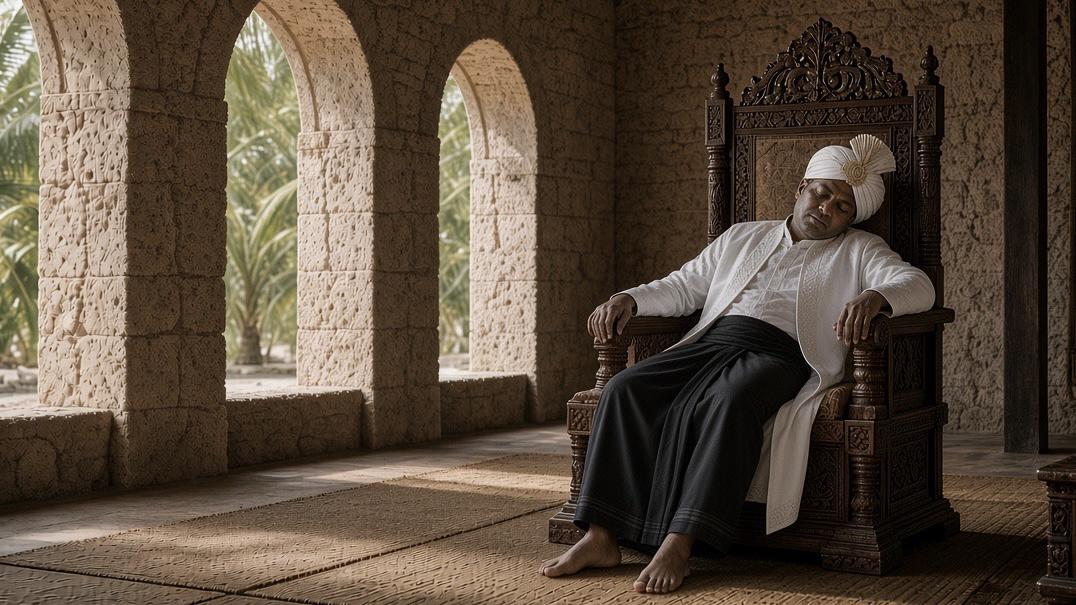
Sultan Muhammad III, Singa Bavana Mahaaradhun ruled the Maldives from 1549 to 1551. He belonged to the Hilaalee Dynasty, which had ruled the Maldives since 1388. His short reign ended with his assassination, after which his half-brother Hasan IX succeeded him. Hasan would later become known as Dom Manoel, making Muhammad III’s death a crucial event in the chain of events that led to the Portuguese intervention in Maldivian affairs.
Early life and family
Muhammad III was a grandson of Sultan Kalu Muhammad, one of the most prominent rulers of the Hilaalee dynasty. According to the genealogical tradition, Muhammad was the son of Omar Maafaiy Kilege, son of Kalu Muhammad, and Golhavahi Aysha Rani Kilege, daughter of Korari Kilege.
He therefore belonged directly to the ruling Hilaalee family and was closely connected to the powerful royal branches that had dominated Maldivian politics during the preceding decades.
Muhammad III succeeded Sultan Hasan VIII, who had ruled the Maldives for approximately twenty years. Hasan VIII was himself a son of Kalu Muhammad.
Thus, Muhammad III’s accession continued the rule of the descendants of Kalu Muhammad.
Accession to the throne
Muhammad III became Sultan in 1549, following the death of Hasan VIII. His reign was brief, lasting approximately two years.
Although little detailed information survives concerning the administration of his reign, the political environment of the Maldives was already highly unstable. The preceding decades had witnessed repeated changes of sovereign, rival branches of the royal family, depositions and violent struggles for the throne.
Muhammad’s own reign would end in precisely such a violent manner.
Assassination
In 1551, Sultan Muhammad III was assassinated by his half-brother Hasan, who immediately succeeded him as Sultan Hasan IX.
The assassination was therefore not merely the death of a Sultan; it directly altered the course of Maldivian history.
Hasan IX’s reign would prove to be one of the most extraordinary episodes in the history of the Maldivian monarchy. He eventually renounced Islam and converted to Christianity. Following his conversion, he was deposed and became known by the Portuguese name Dom Manoel.
The connection between Muhammad III and Dom Manoel is therefore especially important.
Dom Manoel’s conversion subsequently brought the Maldives into a much closer relationship with the Portuguese. He eventually lived under Portuguese protection in Goa and claimed the Maldivian throne from there.
His removal from the throne also produced the first interregnum of 1552–1554, during which the Maldives was governed by a Council of Ministers rather than a Sultan.
This was the beginning of the succession crisis that would eventually lead to the restoration of Dom Manoel as king in absentia, the appointment of regents, and ultimately the rise of Muhammad Thakurufaanu and the struggle against Portuguese influence.
A short reign with enormous consequences
Muhammad III’s reign lasted only around two years, and comparatively little is recorded about his own administration. Nevertheless, his assassination had consequences far beyond the length of his reign.
Had Muhammad III continued to rule, the extraordinary events surrounding his brother Hasan IX might never have unfolded in the same way. Instead, Hasan’s accession led to his conversion, his exile and Portuguese connection, and the emergence of competing claims to the Maldivian throne.
In this sense, Muhammad III occupies a pivotal place in the history of the Maldives. His reign was short, but his violent death opened the succession crisis that eventually brought the Maldivian monarchy into direct confrontation with Portuguese power.
Sultanate of the Maldives

Sultan: Sultan Muhammad III, Singa Bavana Mahaaradhun
Dynasty: Hilaalee Dynasty
Duration: 1549-1551

Predecessor
Sultan Hasan VIII
Hilaalee Dynasty

Successor
Sultan Hassan IX (King Dom Manoel)
Hilaalee Dynasty
____________
Vocabulary
Singa: A name of a Zodiac sign; ♍ Virgo
Bavana: World
Mahaaradhun: Great King


One thought on “Sultan Muhammad III, Whose Death Was Followed by External Aggression”