



The official adoption of Islam by the Maldives in 1153 CE (548 AH) stands as one of the most defining turning points in South Asian history. Marking nearly nine centuries of Islamic heritage, the event transformed a remote, Buddhist island archipelago into a unified Muslim sovereign state. The transition reshaped Maldivian culture, law, architecture, and international trade relations.
However, the exact circumstances under which King Dhovemi Kalaminja (who adopted the title Sultan Muhammad al-Adil) renounced Buddhism and converted to Islam remain a subject of historical debate, rich folklore, and ongoing scholarly study.
1. Folklore & Popular Legend: The Subjugation of Rannamaari
The most famous account of the conversion comes from traditional Maldivian folklore, immortalized by the 14th-century Moroccan traveler Ibn Battuta.
According to legend, the people of Malé were regularly terrorized by an evil sea demon known as Rannamaari, who appeared as a vessel covered in lights once every month. To appease the demon and prevent catastrophe, the kingdom was forced to sacrifice a young virgin woman on the last night of every lunar month. The girl would be left in an isolated seafront temple (Budhakhanu), and by morning, she would be found dead.

As the story goes, a traveling Muslim scholar—traditionally identified in folklore as Abu al-Barakat Yusuf al-Barbari—arrived in the Maldives and stayed with a local family whose daughter was selected for sacrifice. Out of compassion, Abu al-Barakat disguised himself as the girl and waited in the seafront temple overnight while reciting verses from the Quran. When the demon appeared, the continuous recitation of the holy text reportedly weakened and banished the creature forever into the sea.
Grateful for the kingdom’s deliverance from the phantom, King Dhovemi embraced Islam, assumed the title Sultan Muhammad al-Adil, and decreed that all his subjects convert as well.
2. Theoretical Models & Historical Theories
While the legend of Rannamaari holds deep cultural resonance, modern historians, epigraphers, and sociologists view the 12th-century conversion through several distinct analytical frameworks.
A. The Identity Debate: Maghrebi vs. Tabrizi
Historians have long contested the true origins of the scholar credited with introducing Islam to the royal court:
• The Maghrebi/Berber Hypothesis (Abu al-Barakat Yusuf al-Barbari): Supported primarily by Ibn Battuta’s accounts. Battuta recorded that Abu al-Barakat was a scholar from Maghreb (modern North Africa/Berber region). This account is supported by long-standing oral traditions taught across the Maldives.
• The Persian/Tabrizi Hypothesis (Yusuf Shams al-Din al-Tabrizi): Modern archaeological research and inscriptions on the tomb at Medhu Ziyaaraiy in Malé indicate that the scholar was actually Tabrizi (from Tabriz, modern-day Iran). Scholars such as British archaeologist H.C.P. Bell examined early Maldivian texts and copperplates (Loamaafaanu), concluding that a Persian Sufi mystic named Shaykh Yusuf Shams al-Din al-Tabrizi played the pivotal role in converting the court.

B. Geopolitics & Maritime Trade Routes
Another theory relies on Indian Ocean trade dynamics. By the 12th century, Middle Eastern Arab and Persian merchants dominated the maritime Silk Route connecting the Arabian Peninsula, East Africa, South Asia, and China.
The Maldives occupied a crucial geographic position in these trade networks:
1. Cowry Shell Currency: The Maldives was the global capital of cowry shell production (Cypraea moneta), which served as the international medium of exchange across West Africa and South Asia.
2. Freshwater & Provisions: Ocean-crossing dhows depended on the Maldives for fresh water, coir rope (essential for shipbuilding), and rest stops during monsoon transitions.
Converting to Islam opened direct diplomatic and commercial advantages for the Maldivian crown, integrating the island kingdom into the flourishing Indian Ocean Islamic economic sphere.
C. Royal Decree vs. Gradual Islamization
Popular tradition often depicts the nation converting overnight in 1153 CE. However, epigraphic evidence from 12th-century copperplate decrees (Isdhoo and Dhanbidhoo Loamaafaanu) reveals a more gradual and politically managed transition:
• The royal decree initiated at the capital (Malé) took years—and in some southern atolls, decades—to take full effect.
• Buddhist monasteries (viharas) and stupas (havittas) were dismantled, repurposed, or covered, and Islamic religious infrastructure was systematically constructed across the outer atolls.
• Rather than an immediate total erasure, early Maldivian Islam incorporated pre-existing Buddhist architectural methods (such as master coral stone carving) and local cultural customs.
3. Nine Centuries of Impact: Shaping Maldivian Identity
Since 1153 CE, Islam has served as the core foundation of Maldivian sovereignty, social structure, and national unity.
Official Royal Conversion (1153 CE)
1153 CE
King Dhovemi Kalaminja adopts Islam, taking the title Sultan Muhammad al-Adil. The royal dynasty converts the central administration in Malé.
Codification via Loamaafaanu (1190s CE)
1190s CE
Royal copperplates are issued to document the nation’s conversion across outer atolls, establishing Islamic legal frameworks and state-sponsored religious institutions.
Ibn Battuta’s Visit & Legal Reforms (1340s CE)
1343–1344 CE
Famed traveler Ibn Battuta serves as a Chief Judge (Qadi) in the Maldives, documenting life in the islands and reinforcing strict Sunni Maliki jurisprudential norms.
Resistance Against Portuguese Invasion (1558–1573 CE)
1573 CE
Muhammad Thakurufaanu al-Auzam leads a successful war against Portuguese occupiers who attempted to forcibly convert the islands, cementing Islam as the core of national liberation and statehood.
Construction of Male’ Hukuru Miskiy (1656 CE)
1656 CE
Sultan Ibrahim Iskandar I constructs the Old Friday Mosque out of interlocking sea coral, creating a masterpiece of Islamic architectural heritage.
The Legacy Today
Crossing the 900-year milestone, the conversion of 1153 CE remains the defining axis of Maldivian society. The influence of those centuries is visible across the nation:
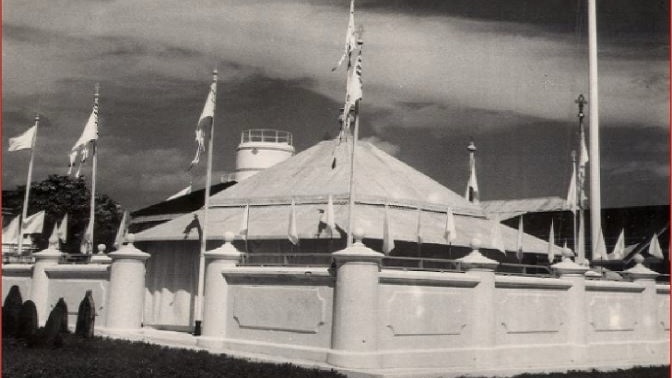
• Coral Stone Mosques: Intricate architectural structures like the Male’ Hukuru Miskiy, built from carved coral stone without mortar, bridge ancient South Asian craftsmanship with Islamic calligraphy.
• Constitutional Unity: Under modern Maldivian law, citizenship remains linked to the Islamic faith, keeping a continuity that traces back to Sultan Dhovemi’s original decree.
• Language & Script: The Dhivehi language adopted significant Arabic, Persian, and Urdu loanwords, evolving alongside the Thaana script written from right to left.
Whether viewed as a divine intervention against a sea monster or a strategic geopolitical shift by a maritime kingdom, the transition from Buddhism to Islam nearly 900 years ago laid the foundation for the contemporary Republic of Maldives.