



In Maldivian woodcraft, carpentry is divided into two distinct realms: thedhui vadaan (straight carpentry, used for furniture and house construction) and kissaru vadaan (curved or bent carpentry, the master craft of vessel building).
Kissaru vadaan is the ancient Maldivian art of naval architecture—the precise, eye-estimated construction of the iconic dhoni and larger ocean-going trading vessels known as vedi. Built entirely without written blueprints, drafted plans, or metal measuring tapes, kissaru vadaan relies on proportions passed down orally through generations.
Origins and Maritime Heritage
The archipelago’s survival has depended on sea navigation for over two millennia. Situated along ancient Indian Ocean trade routes, early Maldivians synthesised naval influences from Arab dhows, South Indian catamarans, and Polynesian hull forms.
Because the low-lying coral atolls lacked large iron reserves or dense oak forests, early master shipwrights—known as Maavadi Kaleyge—developed an indigenous technique using local timber and natural joinery.
Key Distinction: Unlike Western shipbuilding, which constructs a rigid internal skeletal frame before applying the outer planking (frame-first), kissaru vadaan is traditionally a shell-first technique. Master builders shape and join the outer planking of the hull first, inserting internal ribs only after the shell structure takes shape.
Timber Selection: The Secret Lore of Atoll Flora
A hallmark secret of kissaru vadaan lies in how timber was selected to match the stress profiles of different ship parts.
- Dhivehi Ruh (Coconut Palm – Cocos nucifera): Used extensively for hull planking (madhu). In traditional lore, the height of a chosen coconut palm directly dictated the intended length of the small fishing dhoni.
- Kaani (Sea Trumpet – Cordia subcordata): Valued for its natural curve and resistance to rot. Crucial for shaping the stempost (miyaru) and sternpost.
- Midhili / Buni (Country Almond – Terminalia catappa): Dense, oily, and heavy. Used for structural joints and load-bearing keel components (faiy).
- Kuredhi (Ironwood – Pemphis acidula): Exceptionally dense bushwood harvested for wood trunnels (ilaa) or securing pegs exposed to harsh salt spray.
The Construction Methodology
Building a traditional boat takes a crew of around 6 to 8 kissaru vadin (carpenters) roughly 8 to 12 months under the supervision of a single master Maavadi.
- 1. Laying the Keel (Faiy)
Foundational alignment
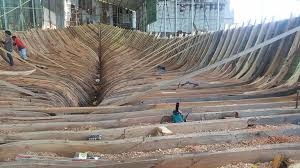
The master builder lays the central keel timber on wooden blocks along the shore. Precise alignment is set using sight lines along the horizon rather than spirit levels. - 2. Raising the Bow (Miyaru) and Stern
Establishing character lines
The curved bow stem—the iconic swept-forward prow—is fitted to the keel using mortise-and-tenon joints secured with hardwood pegs (ilaa). - 3. Planking the Shell (Shell-First Assembly)
Eye-estimation curvature
Planking proceeds upwards from the keel. Planks are hand-planed and bent using controlled heat and steam. Each plank is fitted flush against its neighbor with zero gaps, secured with wooden pegs or coconut fiber stitches (roanu). - 4. Rib Fitting (Vaan)
Structural reinforcement
Once the outer wooden skin reaches the gunwale, naturally curved branches (vaan) are selected to match the interior contour of the hull and fitted inside to lock the shape in place. - 5. Caulking and Sealing
Waterproofing the vessel
Seams between planks are caulked using refined coconut husk fibers soaked in shark liver oil (kalhu theyo) or resinous tree sap, creating a flexible, watertight bond that flexes with wave action.
1. The Proportional Unit system (Athu)
The Maavadi Kaleyge uses body-centric measurement units, primarily the faathaa (span of an open hand) and athu (cubit, from elbow to fingertips). Proportions were kept symmetrical using a cord called a visun roanu. By holding this cord between the bow stem, center point, and stern, the master craftsman detects asymmetry as small as a fraction of an inch simply by feeling tension along the line.
2. The Miyaru Curve (The Shark Bow)
The sweeping, elegant bow stem of a traditional dhoni is named Miyaru after the shape of a shark’s snout. This curve isn’t just aesthetic; it reduces wave resistance in shallow lagoon passes (kanduolhi) and helps lift the vessel over breaking reef rollers.
3. Coconut Oil Curing (Kalhu Theyo)
Traditionally, metal nails were avoided because seawater rapidly corrodes iron and rots the surrounding wood. Instead, boatbuilders used wooden trunnels (ilaa) made from dense hardwoods, soaked in boiled shark liver oil or concentrated coconut oils. This treatment preserved the wood against marine borers (shipworms) for decades.
Modern Evolution and Preservation
Island hubs like Alifushi in Raa Atoll and Velidhoo in Noonu Atoll remain historically famous centers for kissaru vadaan. While fiberglass construction, CAD design, and diesel engines have largely replaced traditional wooden dhonis for commercial transport, master shipwrights still preserve these hand-shaping skills.
Today, kissaru vadaan lives on in high-end resort craft, heritage restoration projects, and handcrafted miniature models displayed across the Maldives as a testament to one of the Indian Ocean’s most sophisticated indigenous maritime traditions.