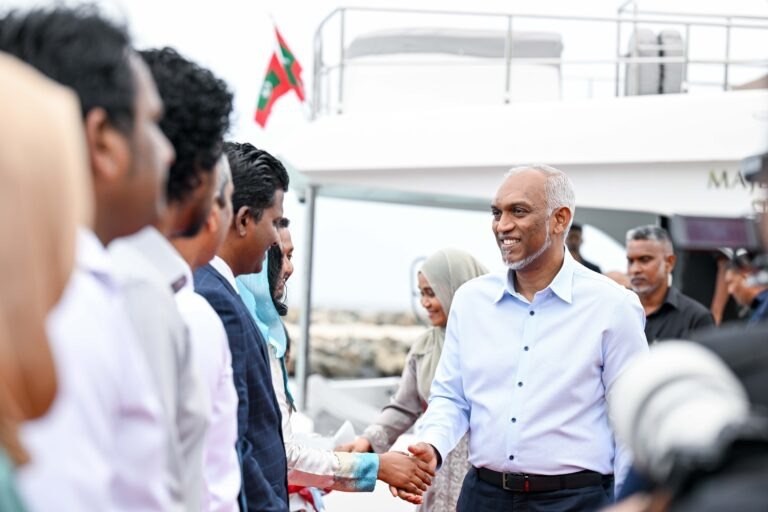




The upcoming Maldives-India Free Trade Agreement (FTA) is poised to inject a massive wave of growth into the local maritime and logistics industries, Economic Minister Mohamed Saeed announced.
Following a series of high-level FTA discussions in India with Indian Trade Minister Piyush Goyal, Saeed sat down with news outlet WION to highlight how the deal is expected to completely reshape regional commerce.
According to Minister Saeed, bilateral relations between the two neighbors have ascended to “new heights,” catalyzed by the recent state visits of Maldivian President Dr. Mohamed Muizzu to India and Indian Prime Minister Narendra Modi to the Maldives. Recent high-profile business forums held across New Delhi, Mumbai, and Bengaluru have further unified the public and private sectors of both nations.
Slashing Friction, Boosting Supply Chains
The Minister emphasized that the cornerstone of the FTA lies in its potential to clear red tape and reduce the overall overhead costs of doing business.
“The Free Trade Agreement will streamline customs procedures, reinforce regulatory cooperation, and dismantle existing barriers to trade,” Saeed explained. “As a result, we will see reduced transactional costs, heavily optimized regional supply chains, and a far more favorable ecosystem for maritime industries and ocean-bound commerce.”
Compounding this momentum is the Bilateral Investment Treaty (BIT), for which negotiations have wrapped up. Minister Saeed noted that the BIT will provide a transparent, rule-based framework, giving international investors much-needed clarity and confidence.
Diversification and the Digital Frontier
The ripple effects of these agreements are projected to encourage prominent Indian investors to venture heavily into key Maldivian sectors—including logistics, tourism, healthcare, education, renewable energy, and marine industries.
Crucially, Saeed pointed out that the strategic deal isn’t just about scaling existing trades. It is a calculated move to diversify the Maldivian economy away from over-reliance on singular streams, unlocking brand-new markets for the domestic fishing industry and value-added marine products. It will also help effectively plug small and medium enterprises (SMEs) directly into a booming regional network.
Beyond physical shipping lines, the deal touches on tech and tourism. India is expected to play a vital supporting role in realizing President Muizzu’s ambitious goal of expanding the digital sector to comprise 33% of the Maldivian economy. Furthermore, discussions are underway to tighten air connectivity between the nations to keep tourism numbers climbing.
Global Player Status
The ultimate goal, according to the Maldivian administration, is to utilize these treaties to transform the Maldives into a resilient, globally competitive economy capable of weathering external market shocks.
With the Maldives-India Free Trade Agreement slated for practical implementation later this year, the government is currently engaging with local business owners to gather industry feedback.
Once fully realized alongside the Maldives’ existing free trade agreement with China, the archipelago will uniquely hold direct, friction-free trade pipelines into two of the largest consumer bases on the entire planet.