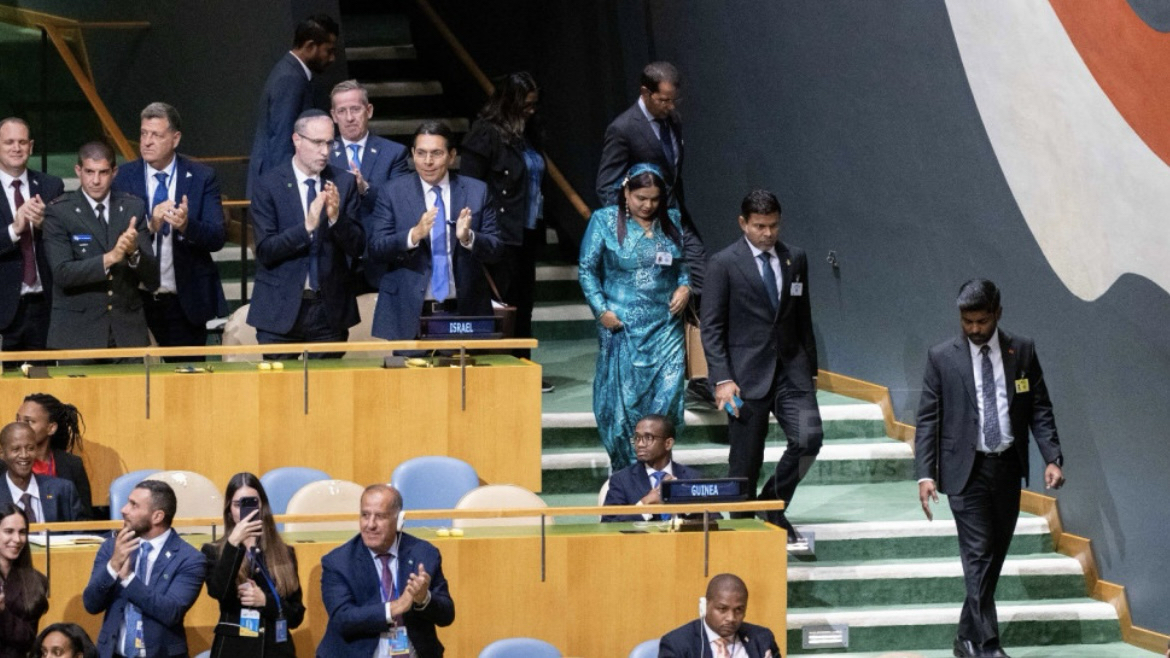


The Maldives has condemned the closure of the Strait of Hormuz, warning that disruptions to maritime traffic through the strategic waterway can have direct consequences for fuel prices, food supplies, air travel, tourism and public finances in the Maldives.
Addressing the United Nations General Assembly, Vice President of the Maldives said the Indian Ocean must remain peaceful and a region where trade can flow and states can prosper.
He said “the Maldives condemns the closure of the Strait of Hormuz and called for the waterway to remain open and safe”
He said the Maldives was particularly concerned by the disruption to maritime traffic through the Strait of Hormuz, noting that interruptions to shipping can raise fuel prices while affecting food supplies and air travel.
“The consequences of these are felt across tourism and public finances in the Maldives,” the Vice President said.
He called for the Strait of Hormuz to remain open and safe, stressing the importance of freedom of navigation and uninterrupted trade.
The Vice President also condemned attacks on Saudi Arabia, the United Arab Emirates, Bahrain, Qatar, Kuwait, Oman and Jordan, while welcoming diplomatic efforts by Oman, Pakistan and Qatar aimed at de-escalating tensions and bringing the parties to dialogue.
The remarks come as the Maldives continues to face significant exposure to disruptions in global energy and supply chains because of its dependence on imported fuel and goods.
In a UN statement earlier this year, the Maldives said developments in the Strait of Hormuz were of particular concern because the country’s people, goods and services depend heavily on maritime and air connectivity. The Maldives called for the restoration and preservation of “safe, secure and unimpeded navigation” through the Strait, describing the waterway as vital to global trade, energy flows and regional connectivity.
The Maldives also co-sponsored a draft UN Security Council resolution on the Strait of Hormuz in May, saying it supported maritime security, safe navigation and the protection of international trade and supply chains. The government also warned of the humanitarian and economic effects of global supply-chain disruptions on vulnerable economies.
The government has repeatedly highlighted the wider economic risks from the regional conflict.
In March, President Dr Mohamed Muizzu said the Maldives was significantly affected by the situation because of its dependence on the Middle East for tourism, food supplies and fuel. He said the government was taking measures to safeguard the country’s interests amid the regional tensions.
The President also said that measures were being taken to protect tourism, reroute travel and strengthen the national airline’s capacity, while assuring that there was no immediate risk of fuel or food shortages at the time.
The Maldives’ position has also included repeated calls for de-escalation and diplomacy. In June, the government welcomed the US-Iran memorandum of understanding, particularly measures aimed at ensuring freedom of navigation in the Strait of Hormuz, and commended the diplomatic efforts of Pakistan, Qatar and other regional and international partners.
More recently, the Maldives has continued to condemn attacks affecting Gulf states and critical infrastructure. In March, the government condemned attacks targeting energy facilities in Iran as well as attacks on commercial and energy facilities in Saudi Arabia, the UAE, Qatar and Kuwait, warning that attacks on critical infrastructure threaten regional stability and global energy security.
The Maldives’ concerns also reflect the country’s broader vulnerability to external energy shocks. In a UN statement earlier this year, the Maldives said it spends an average of nearly $445 million annually on diesel imports, much of it for electricity generation, while petroleum product imports reached more than $1.165 billion in March alone. The statement said the country’s dependence on imports exposes it to external price shocks and disruptions in global supply chains.
The Vice President’s remarks at the UN therefore place the Strait of Hormuz within a wider Maldives position: that disruptions to major international trade and energy routes can directly affect the economic security and policy choices of small island states.