




Sultan Ali ibn Abdur Rahman Vazir Auzam, Siri Audha Siyaaka Kaththiri Mahaaraadhun, better known in Maldivian history as Sultan Ali Rasgefaanu – a sultan of Hilaalee Dynasty who was one of the shortest-reigning yet most enduringly remembered rulers of the Maldives. His reign lasted only about two months and fourteen days, but his death in 1558 became one of the defining moments in the country’s struggle against Portuguese intervention.
Today, Ali Rasgefaanu is remembered not simply as a former Sultan, but as a shaheed (martyr) and national hero, having been killed while personally fighting Portuguese forces attempting to seize Malé.
A Sultan in a time of crisis
Ali Rasgefaanu came to the throne during one of the most turbulent periods in Maldivian history. The Sultanate was experiencing intense internal political rivalries while the Portuguese were expanding their influence across the Indian Ocean.
The crisis was closely connected to Sultan Hassan IX, who had been overthrown and subsequently sought Portuguese assistance to regain the Maldivian throne. Hassan converted to Christianity in Cochin and took the name Dom Manoel, while continuing to claim the Maldivian crown. Portuguese intervention in Maldivian affairs consequently became increasingly direct.
Ali Rasgefaanu continued the resistance against the Portuguese presence. Historical genealogical records identify him as the son of Amir Sayyid Abdur Rahman Ba Alawi Dorhimeyna Kilegefaanu, and his mother as Sitti Kamba’adi Kilege, daughter of Bodu Niyame Thakurufaanu of Feridu.
There is relatively little surviving information about his personal life, education or personality. What the historical record preserves most clearly is his political and military role during this crisis.
His brief reign
According to the traditional Maldivian Tareekh, Ali became Sultan in 1558 and was martyred only two months and fourteen days later.
His short reign is particularly remarkable because he inherited a country already facing external military pressure and internal divisions. Rather than surrendering to the Portuguese threat, he continued the resistance.
The Portuguese eventually launched their decisive expedition against Malé in 1558. Their forces were associated with the commander known in Maldivian tradition as Andhiri Andhirin, or Andreas Andre.
On the battle ground
The traditional account of Ali Rasgefaanu’s final day is one of the reasons his memory became so powerful in Maldivian history.
On 19 May 1558, Portuguese forces landed on the northwestern side of Malé. Sultan Ali personally went out to confront them, carrying his sword and shield.
The fighting had already weakened the Maldivian defenders. According to the historical account, by the time Ali reached the area around Eid Miskiy in Maafannu, only his Prime Minister and two companions remained with him. The rest of his forces had either been killed or withdrawn.
Despite being vastly outnumbered, Ali and those accompanying him continued to fight.
The Portuguese opened fire. Ali’s two companions were killed, and Sultan Ali Rasgefaanu himself was then killed in the battle.
The traditional account therefore presents his death not as an execution or assassination after surrender, but as the death of a ruler fighting the invading forces himself.
His martyrdom occurred on 1 Sha’ban 965 AH, corresponding to 19 May 1558.
His Martydom and the Portuguese occupation
Ali’s Martydom had consequences far beyond his own reign.

Following the Portuguese victory, the Portuguese established control over Malé and administered the Maldives on behalf of the exiled Dom Manoel (Hassan IX). Portuguese rule lasted approximately 15 years, from 1558 until 1573.
The occupation became associated with attempts to impose Portuguese authority and Christianity, as well as economic and political exploitation. Eventually, resistance culminated in the uprising led by Muhammad Thakurufaanu al-Auzam and his brothers, which expelled the Portuguese from the Maldives in 1573. This day is celebrated in the Maldives as the National Day.
In this sense, Ali Rasgefaanu’s death stands at the beginning of the Portuguese occupation era, while Muhammad Thakurufaanu’s victory 15 years later brought that era to an end.
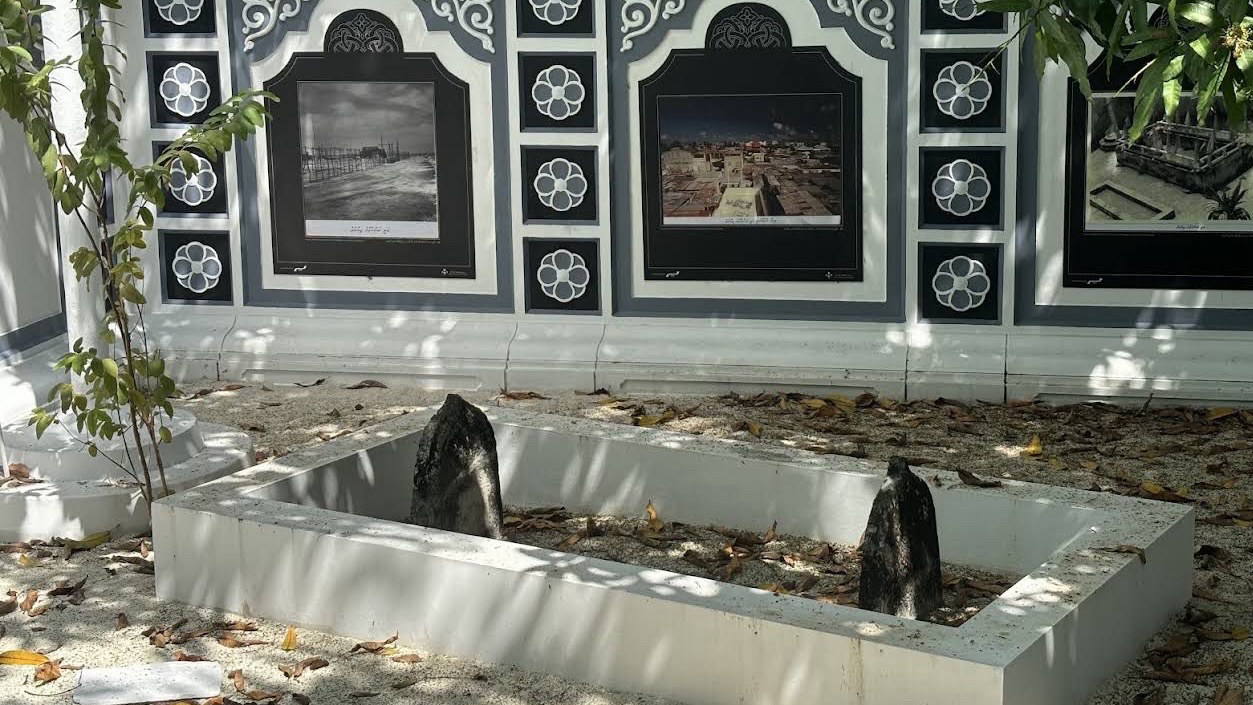
One of the most significant physical reminders of Ali Rasgefaanu is his tomb in Malé.
The site is known as Ali Rasgefaanu Ziyaarai. According to UNESCO’s documentation on Maldivian heritage, the shrine contains the tomb of Sultan Ali VI, who was martyred by the Portuguese in 1558. Most significantly, the tomb was erected on the exact spot where he fell in battle.
The location was originally part of the lagoon around Malé before the surrounding land was reclaimed.
That makes the site more than simply a royal tomb: it is traditionally regarded as the actual place where the Sultan gave his life defending the country.
How the Maldives honors him today
Ali Rasgefaanu is remembered as a shaheed, meaning a martyr, and as one of the country’s national heroes.
His martyrdom is commemorated through Martyrs’ Day (Shaheedhunge Dhuvas). The date is connected to the Islamic calendar because his death occurred on 1 Sha’ban, meaning the corresponding Gregorian date changes from year to year.
His shrine, Ali Rasgefaanu Ziyaarai, remains an important historical monument in Malé.
His legacy is not confined to the shrine where he fell. The road beside his resting place is officially known as Shaheed Ali Hingun, meaning “Martyr Ali Road,” preserving his title of martyr in the modern geography of Malé. Every day, people passing through the road encounter the name of the Sultan who gave his life defending the Maldives.
His name also continues to appear in official and public commemorations of Maldivian national heroes. Modern Maldivian accounts emphasize that although his reign was extraordinarily short, his decision to confront the Portuguese and his death in battle cemented his place in the national memory.
A legacy much larger than his reign
There is an interesting paradox to his place in Maldivian history.
He was Sultan for only around two months.
Yet centuries later, his name remains associated with one of the country’s most important ideals: defending the independence and Islamic identity of the Maldives against foreign domination.
He did not live to see the Portuguese occupation that followed his death, nor did he see their eventual expulsion in 1573. But his death became part of the larger story of Maldivian resistance that ultimately culminated in Muhammad Thakurufaanu’s liberation of Malé.
His reign was short.
His kingdom was temporarily conquered.
But his final act — a Sultan taking up his sword and personally confronting the invading army — became the foundation of his legacy as Shaheed Sultan Ali Rasgefaanu.
Sultanate of the Maldives

Sultan: Sultan Ali IV, Siri Audha Siyaaka Kaththiri Mahaaraadhun
Dynasty: Hilaalee Dynasty
Duration: 1557-1558 (2 months and 14 days)

Predecessor
Sultan Abu Bakr II
Hilaalee Dynasty

Successor
King Dom Manoel (Sultan Hassan IX)
Hilaalee Dynasty
(Portuguese-occupied Sultanate of the Maldives)
____________
Vocabulary
Rasgefaanu: King
Mahaaraadhun: Great King
Audha: Honorable
Kaththiri: Strong, Warrior
Ziyaarai: Shrine
Siri: Glorious

2 thoughts on “Sultan Ali Rasgefaanu: The Martyr Who Fell Defending the Maldives”