
Lightning is plasma. The Sun is plasma. Neon signs glow because of it. So is the flame on a candle a plasma too?
The short answer is mostly no. An everyday flame is hot gas, and only a tiny share of it is ionised.
What plasma is
Plasma is often called the fourth state of matter, after solids, liquids and gases. According to NASA, a plasma forms when electrons are separated from the outer orbits of a material’s atoms, leaving a mix of charged particles.
Heat is the usual way to get there. The hotter a gas becomes, the more of its atoms lose electrons. The US Department of Energy says high-temperature plasmas can be hotter than 10,000°F, and in them all the atoms can be fully ionised.
Why a candle flame falls short
A candle flame is too cool to count. Its hottest part reaches roughly 1,400°C, which is not enough to ionise much of the gas.
Physicists describe ordinary flames as weakly ionised. They hold enough charged particles to be noticed, but far fewer than lightning or the Sun.
Gas furnaces use that small charge in practice. A flame sensor passes a tiny current through the ions in the flame to confirm the burner is lit, a method known as flame rectification.
Where a flame’s colours come from
A flame’s glow is not plasma light. It comes from two other sources:
- Yellow: tiny particles of soot that heat up until they glow. This yellow zone gives off most of a candle’s light.
- Blue: excited C₂ and CH molecules near the base of the flame, which release their extra energy as light.
It comes down to heat
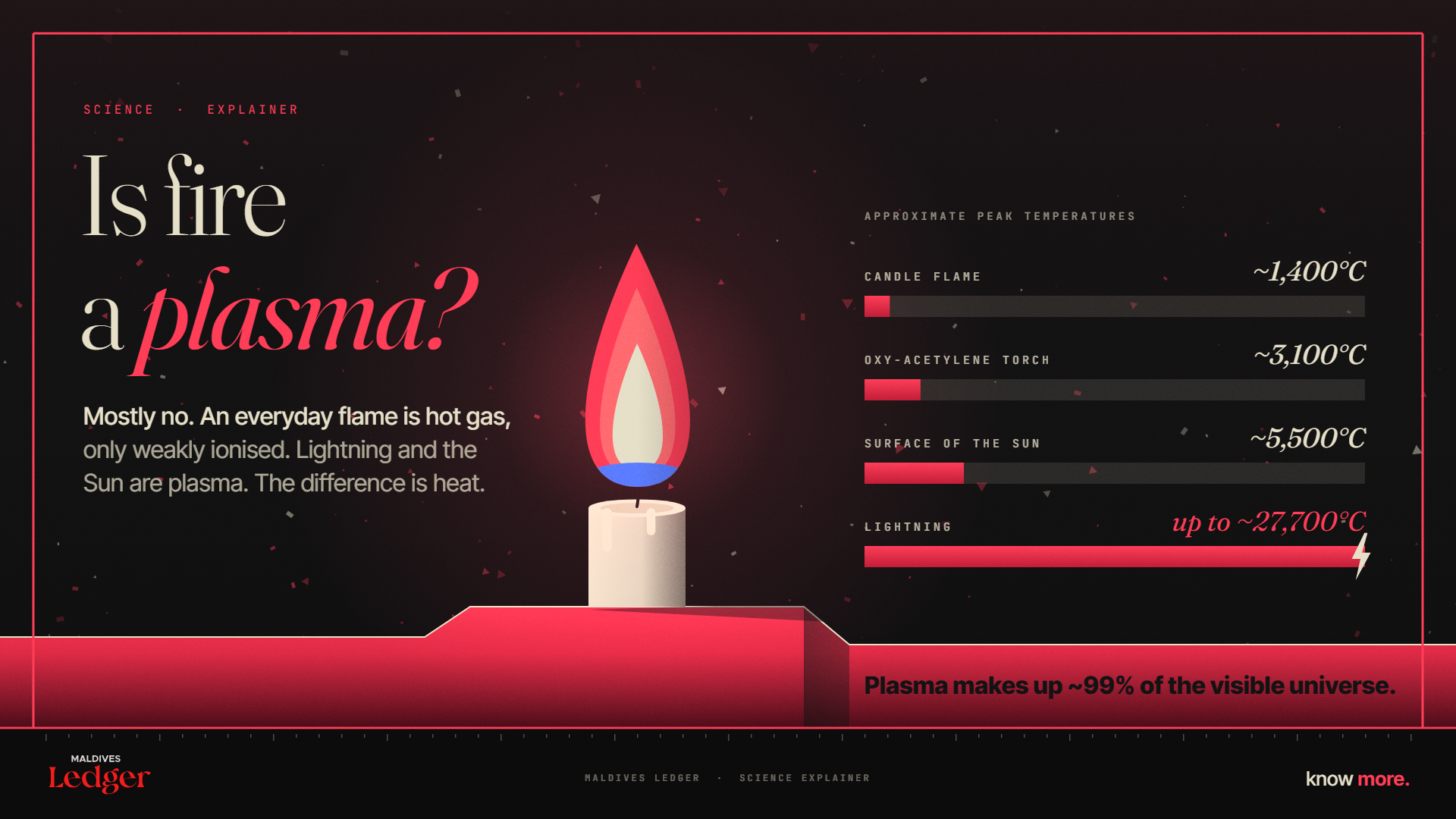
Approximate peak temperatures show how wide the gap is:
- Candle flame: about 1,400°C
- Oxy-acetylene torch: about 3,100°C
- Surface of the Sun: about 5,500°C
- Lightning: heats the air to about 50,000°F (roughly 27,700°C), about five times hotter than the Sun’s surface, according to the US National Weather Service
At the hotter end of the flame scale, the picture changes. An oxy-acetylene flame at around 3,100°C is probably a plasma, at least in part.
Plasma is everywhere
Plasma may be rare in daily life, but it is the most common state of matter we can see. NASA says plasmas make up about 99% of the visible universe.
On Earth, familiar examples include:
- Lightning
- Neon signs
- Auroras, such as the northern lights
So the next time you light a candle, you are looking at hot, glowing gas with only a trace of plasma. For the real thing, look up at a storm, or at the Sun.