

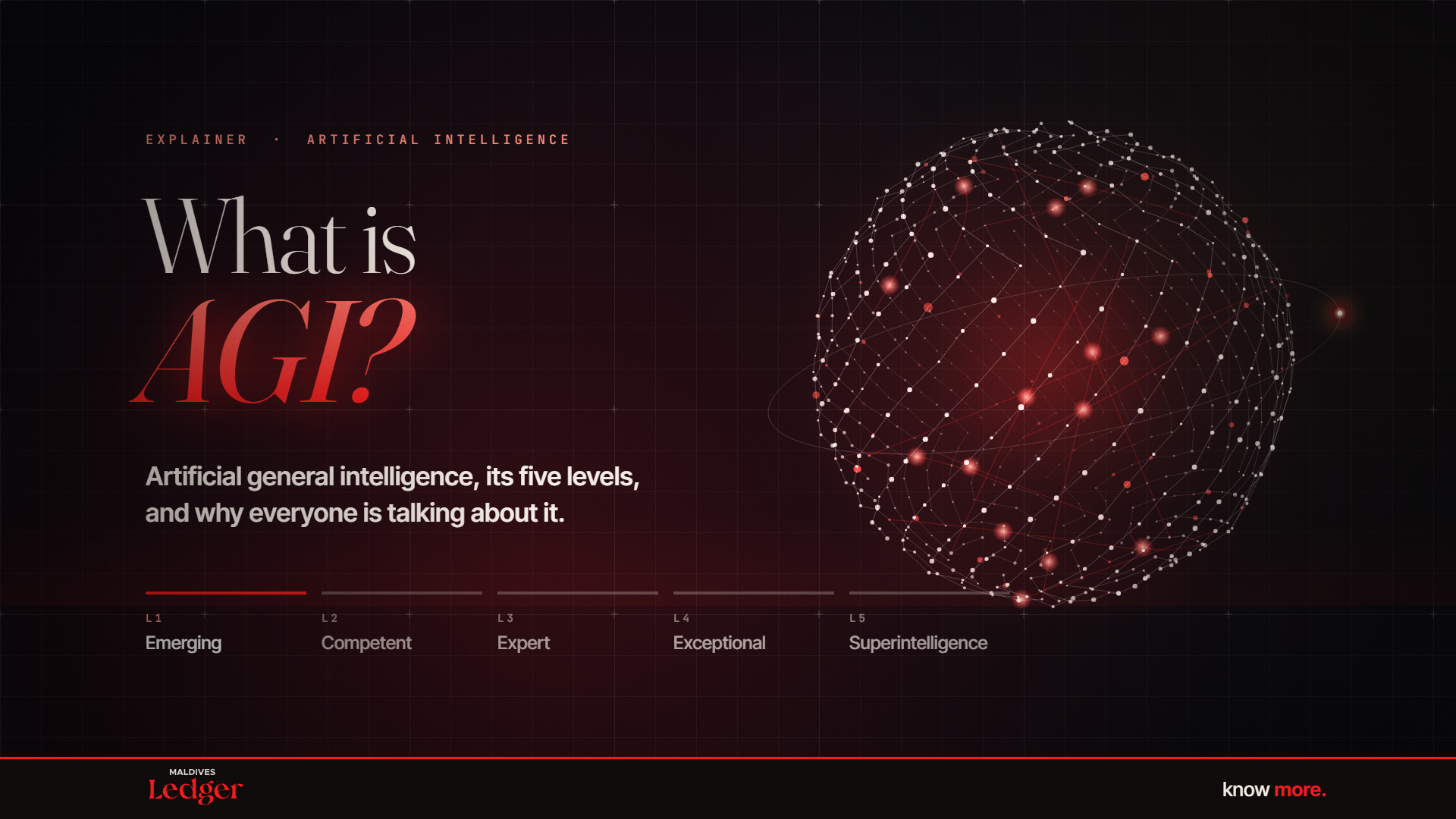
AGI, short for artificial general intelligence, is one of the most talked-about ideas in technology. It describes AI that can match or beat people across a wide range of tasks, rather than being good at just one thing.
How is AGI defined?
There is no single agreed definition. OpenAI, the company behind ChatGPT, describes AGI in its charter as “highly autonomous systems that outperform humans at most economically valuable work.”
Narrow AI vs general AI
Researchers at Google DeepMind separate AI into two kinds:
- Narrow AI handles a clearly scoped task or set of tasks, such as playing chess.
- General AI handles a wide range of non-physical tasks, including learning new skills.
The five levels of AGI
In a paper titled “Levels of AGI”, first published in November 2023 and presented at the ICML 2024 conference, Google DeepMind researchers proposed measuring progress in levels based on how well an AI performs compared with people:
- Level 1, Emerging AGI: equal to or somewhat better than an unskilled human.
- Level 2, Competent AGI: at least as good as 50% of skilled adults.
- Level 3, Expert AGI: at least as good as 90% of skilled adults.
- Level 4, Exceptional AGI: at least as good as 99% of skilled adults.
- Level 5, Artificial Superintelligence (ASI): outperforms 100% of humans.
At the time of writing, the paper placed chatbots such as ChatGPT and Gemini at Level 1, Emerging AGI, and described Competent AGI as not yet achieved. The authors note that their placements are approximate and that the paper does not propose a benchmark.
Why it is in the news
AGI was a talking point at Microsoft Ignite in San Francisco this month. Speaking at a roundtable after the keynote, Microsoft chief executive Satya Nadella described himself as “AGI pilled” and asked: “If intelligence has network effects, what is the future of a firm?”
His remarks did not suggest that AGI has already been achieved.
When will AGI arrive?
No one knows. Even OpenAI’s charter states that “the timeline to AGI remains uncertain.”