

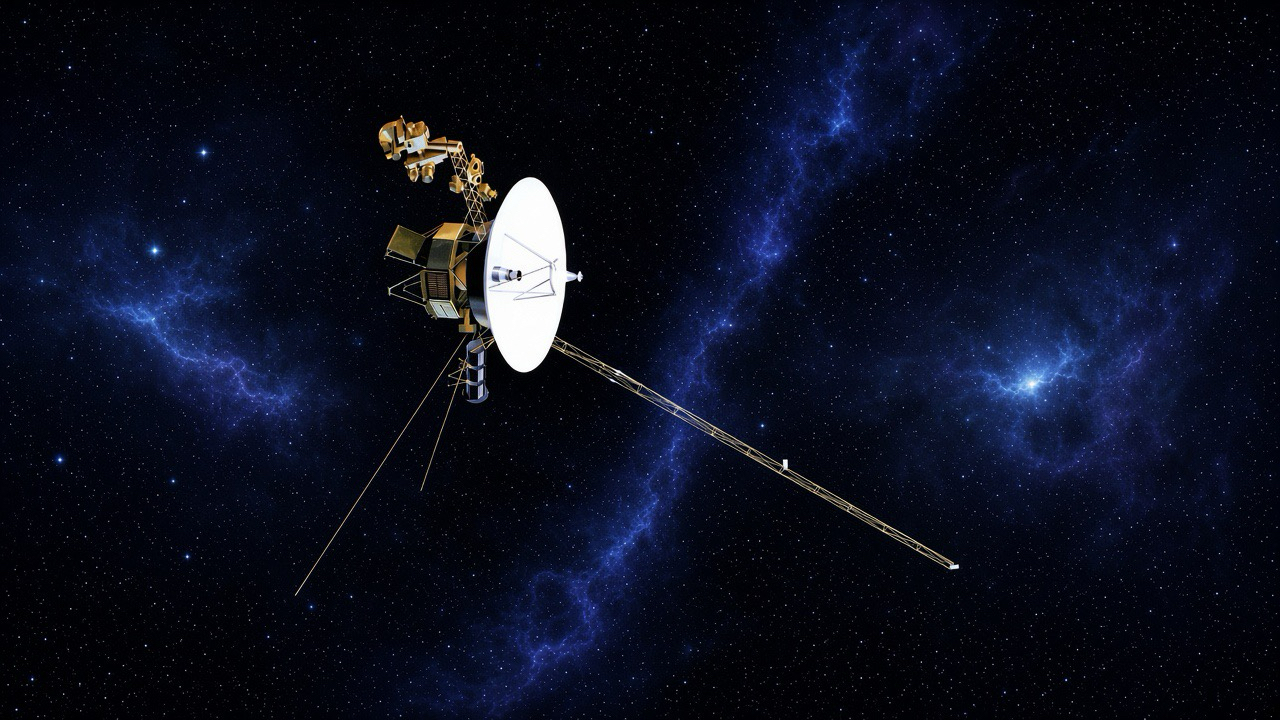
NASA’s Voyager 1 spacecraft has reached a distance of one light-day from Earth, becoming the first human-made object to travel so far from the planet, marking another historic milestone in a mission that has continued for nearly five decades.
The spacecraft reached the milestone on Wednesday, November 18, 2026, at 5:16 a.m. Eastern Standard Time, travelling approximately 16.094 billion miles (25.902 billion kilometres) from Earth. One light-day is the distance light travels in 24 hours, at approximately 299,792 kilometres per second.
The achievement means that radio signals sent from Earth now take approximately 24 hours to reach Voyager 1. Similarly, any response transmitted by the spacecraft takes another 24 hours to return, meaning a complete exchange of messages requires approximately 48 hours, even when both sides respond immediately.
Travelling at approximately 61,000 kilometres per hour, Voyager 1 took 49 years, two months and 11 days to reach the one-light-day distance after its launch in September 1977.
Nearly 50 Years of Exploration
Voyager 1 was launched by NASA on September 5, 1977, from Cape Canaveral, Florida, as part of a mission to explore the outer planets of the Solar System.
During its journey, the spacecraft conducted close flybys of Jupiter in March 1979 and Saturn in November 1980, sending back valuable observations and images that helped scientists better understand the planets, their moons and their surrounding environments.
Following its encounter with Saturn, Voyager 1 continued travelling towards the outer reaches of the Solar System rather than proceeding to Uranus and Neptune, which were later explored by its twin spacecraft, Voyager 2.
One of the most recognised images associated with Voyager 1 is the ‘Pale Blue Dot’, captured on February 14, 1990. The photograph showed Earth as a tiny point of light against the vastness of space, from a distance of approximately 6 billion kilometres.
The image became one of the most iconic photographs in the history of space exploration, illustrating the scale of the universe and the smallness of Earth within it.
In August 2012, Voyager 1 crossed the heliopause, the boundary marking the outer edge of the Sun’s heliosphere, becoming the first spacecraft to enter interstellar space. The heliosphere is a vast protective bubble created by the solar wind and the Sun’s magnetic field.
Voyager 1 is now travelling through interstellar space, beyond the region dominated by the Sun’s influence, and remains the most distant human-made object from Earth.
Still Operating Despite Declining Power
Despite being launched nearly 50 years ago, Voyager 1 continues to operate and transmit scientific information from interstellar space.
However, maintaining communication and scientific operations has become increasingly challenging as the spacecraft’s power supply declines.
Voyager 1 is powered by radioisotope thermoelectric generators, which produce electricity from the heat released by the radioactive decay of plutonium-238. Both Voyager spacecraft lose approximately four watts of electrical power each year as their plutonium fuel gradually decays.
To extend the mission, NASA has progressively switched off non-essential systems and scientific instruments to conserve the remaining electricity.
In September 2026, engineers completed a major power-saving operation known as the ‘Big Bang’, during which three devices were switched off and replaced with lower-power alternatives. The operation was designed to reduce energy consumption while maintaining the spacecraft’s ability to operate in the extremely cold conditions of interstellar space.
NASA said the operation would allow Voyager 1’s remaining scientific instruments to continue functioning longer than previously anticipated. Without the adjustments, another scientific instrument could have needed to be switched off as early as summer 2027.
The spacecraft also experienced an unexpected communications interruption on October 18 and 19, 2026. NASA’s Deep Space Network was unable to detect its radio signal during two scheduled communication attempts. The signal reappeared on October 20, after approximately 48 hours.
Engineers determined that one group of thrusters had gone offline and that the spacecraft had automatically activated its backup thrusters. The exact cause of the incident remained under investigation following the restoration of communication.
Carrying a Message From Earth
Alongside its scientific instruments, Voyager 1 carries one of the most distinctive objects ever sent into space: the Golden Record.
The 12-inch gold-plated copper disc was designed as a message representing Earth and humanity, in the event that the spacecraft is ever discovered by an extraterrestrial civilisation.
Developed with the involvement of astronomer Carl Sagan and his team, the record contains greetings in 55 languages, 115 encoded images, sounds from nature, human sounds, music from different cultures and historical periods, and recorded messages from Earth.
Among the sounds included are thunderstorms, wind, ocean waves, human laughter and a heartbeat. The record also contains a message from then-US President Jimmy Carter.
The Golden Record was intended to provide a representation of life and civilisation on Earth rather than serve as a conventional communication device. Voyager 2 also carries an identical record.
Where Is Voyager 1 Heading?
Voyager 1 is continuing its journey through interstellar space and is travelling in the direction of the star Gliese 445, also known as AC +79 3888, located more than 17 light-years from Earth.
NASA estimates that the spacecraft will pass approximately 1.7 light-years from the star in around 40,000 years. Although Voyager 1 is travelling at approximately 61,000 kilometres per hour, this is relatively slow compared with the speed of light.
The spacecraft is also expected to continue towards the distant Oort Cloud, a vast region believed to contain icy objects surrounding the Solar System. Reaching the inner region of the cloud could take approximately 300 years.
NASA expects Voyager 1 to eventually lose the ability to communicate with Earth as its remaining power supply continues to decline. However, even after its scientific mission ends, the spacecraft will continue travelling through the galaxy.
The one-light-day milestone does not mark a physical change to Voyager 1 or its surroundings. Instead, it demonstrates the extraordinary distance the spacecraft has travelled and the engineering achievements that have allowed it to remain operational for nearly half a century.