
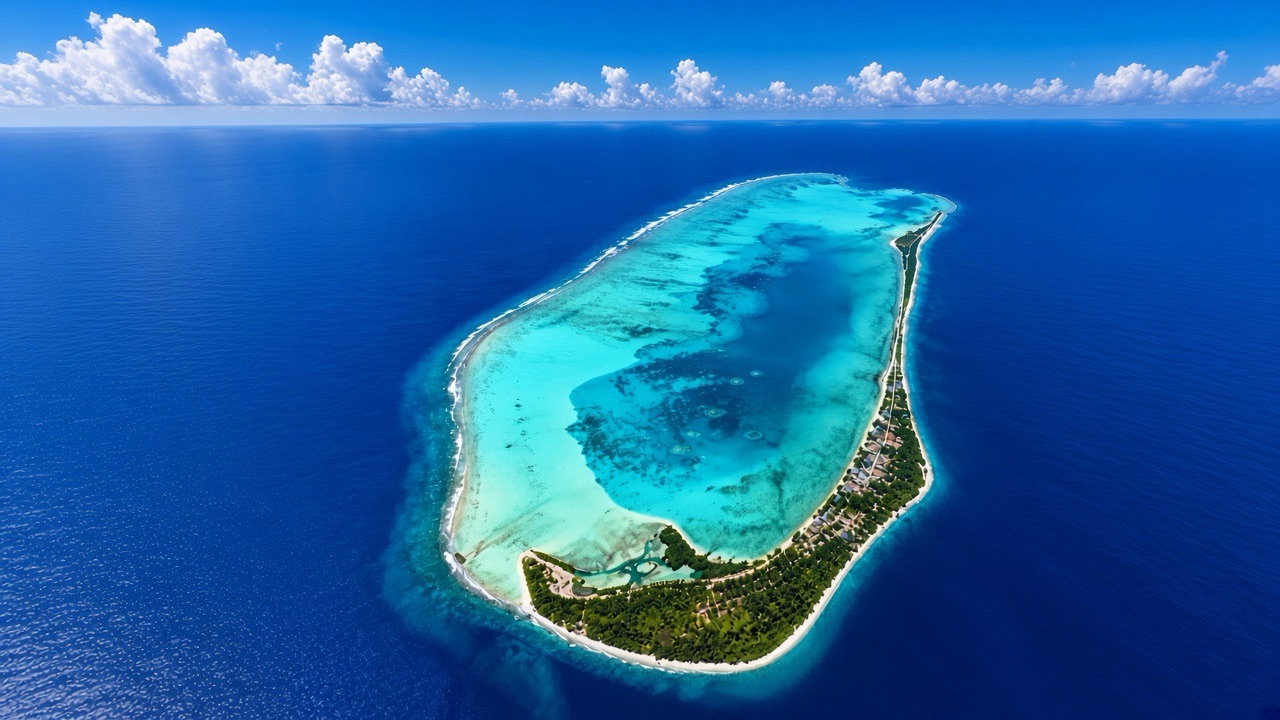
Maliku, officially known as Minicoy, is today administered by India as part of the Union Territory of Lakshadweep. However, the island has a long history of political, cultural and familial connections with the Maldives, having formed part of the Maldivian realm before colonial rule and modern national borders separated the two.
Located approximately 125 kilometres north of Thuraakunu, the northernmost inhabited island of the Maldives, Maliku is geographically closer to the Maldivian archipelago than to mainland India. Its people, known as Malikuns or the Mahl people, share the Maldivian language, religious traditions and cultural heritage, with historical records and oral histories documenting these connections.
Maliku: The Historic Northernmost Territory of the Maldives
Maliku was historically known as Maliku Atoll and formed the northernmost part of the Maldivian realm. The extent of the kingdom was traditionally expressed through the term Malikaddu Midhemedhu, referring to the territory stretching from Maliku in the north to Addu in the south.
The expression appeared in royal documents issued by Maldivian rulers. A particularly significant example is a royal grant issued in 1696 during the reign of Sultan Mohamed IV. The document, concerning the construction and maintenance of a mosque in Finey, Thiladhummathi Atoll, described the Sultan’s sovereignty over the territory between Maliku and Addu.
How Maliku became separated from the Maldives
Maliku’s political authority changed several times during the sixteenth and eighteenth centuries.
During the reign of Sultan Kalu Muhammad (1491–1529), the island came under the authority of the Ali Rajas of Cannanore, a South Indian ruling dynasty based in present-day Kannur, Kerala. It remained under their control for more than a century.
During the reign of Sultan Ibrahim Iskandar I (1648–1687), Maldivian forces confronted the Ali Raja over attacks and demands for tribute. Following the military campaign, Maliku was brought back under Maldivian Sovereignty.
The island remained part of the Maldivian realm until 1752, when the Ali Raja’s forces invaded the Maldives, captured Malé and took Sultan Mohamed Imaduddeen and members of the royal family captive. The Sultan was eventually taken to Maliku, where he died in captivity.
The French traveller François Pyrard de Laval, who visited the Maldives between 1602 and 1607 and subsequently stopped at Maliku, recorded that the islanders shared the customs, manners and language of the Maldivians. He also described the island’s earlier political relationship with the Maldives and its connections with the royal family.
British colonial rule and the separation of the island
Maliku’s political separation became more firmly established with the expansion of British power in South India.
On 18 December 1790, the Ali Raja surrendered authority over the island to the British East India Company, although the ruling family was initially permitted to continue administering it in return for tribute.
British control increased during the nineteenth century, and Maliku eventually became part of British India. Following India’s independence in 1947, it became part of the Indian Union and was subsequently incorporated into the administrative structure of Lakshadweep during the territorial reorganisation of 1956.
Today, Maliku remains part of India’s Union Territory of Lakshadweep. The 1976 maritime boundary agreement between India and the Maldives established the present maritime boundary between the two countries.
The people of Maliku: An ethnic connection with the Maldives
The inhabitants of Maliku are also identified as the Mahl people. They form a distinct ethnic community in India with historical and ancestral connections to the Maldives.
Their origins are preserved through local oral traditions and family histories. One prominent tradition describes the arrival of two Maldivian princesses, Kamborani and Kohoratukamana. According to the account, the Tivaru, who inhabited the island before their arrival, departed for Sri Lanka.
The descendants of Kamborani became associated with the Bodun, traditionally landowners and shipowners, while those of Kohoratukamana were associated with the Niyamin, who served as captains. Other traditional social groups included the Medhukembin, who worked as fishermen, seamen and craftsmen, and the Raaverin, associated with palm tapping and other land-based occupations.
Another oral tradition traces the origins of the Thakru community to an ancestor who travelled to Maliku from Addu Atoll in the Maldives and established a family there.
They preserve specific ancestral connections between Maliku and different parts of the Maldivian realm.
Mahl: A language that traces its name to the Maldives
The native language of Maliku is Dhivehi, The islanders themselves traditionally call it Mahal Bas, also known as Mahl.
Just as the Maldives has regional dialects such as Addu Bas, Fuvahmulaku Bas and Huvadhoo Bas, Maliku Bas is another dialect of the same Maldivian language. The different names reflect the terminology used by the two communities rather than separate linguistic identities.
The name Mahl is associated with Mahaldheeb, a historical name used for the Maldives.
According to an account of its naming during British colonial rule, a British official visiting Minicoy asked a local islander which language he spoke. The islander reportedly answered, “Dhivehi-bas”. When the official did not understand, the islander explained by referring to Mahaldeebu. The official subsequently recorded the language as Mahl.
The island itself is locally known as Maliku in Dhivehi Language.
Maliku Bas shares its linguistic foundations with Dhivehi while retaining distinctive regional expressions, vocabulary and older linguistic features.
Maliku also traditionally uses Thaana, the same writing system used in the Maldives. The shared language and script reflect the island’s place within the wider Maldivian linguistic heritage.
Shared religion and a Buddhist past
Maliku and the Maldives share a religious history that predates Islam. Both had Buddhist populations before their conversion, with archaeological discoveries in Maliku revealing remains associated with Buddhist activity, alongside the extensive evidence of the Maldives’ pre-Islamic Buddhist civilisation.
The Maldives traditionally dates its conversion to Islam to 1153 CE, during the reign of King Dhovemi.
Today, the overwhelming majority of Maliku’s population is Muslim, predominantly following Sunni Islam and the Shafi’i school of jurisprudence, as does the majority of the Maldivian population.
Culture and traditions that remain close to the Maldives
Despite centuries of political separation, People of Maliku have retained cultural practices that reflect their historical relationship with the Maldives.
Traditional performances such as Maldivian style songs and Dances remain part of Maliku’s cultural heritage, alongside other musical traditions, clothing, family customs and maritime practices that share similarities with those found across the Maldives.
Fishing, seafaring, boatbuilding and maritime trade have historically played central roles in island life. Travel, marriage and family connections with the Maldives helped maintain these cultural relationships across generations.
Pyrard de Laval’s seventeenth-century account is particularly significant, as he described the people of Maliku as sharing the customs, manners and language of the Maldivians.
A distinct Maldivian heritage within India
Maliku’s historical and cultural identity distinguishes it from many other islands in Lakshadweep. While Malayalam is widely spoken across much of the archipelago, Maliku retains Dhivehi as its native language, spoken in its regional form, Maliku Bas.
Its use of Thaana, predominantly Sunni Muslim population, oral traditions and cultural practices further reflect its historical connections with the Maldives.
The distinction between present nationality and historical identity remains important. Maliku is part of India today, but its people have retained a distinct heritage rooted in centuries of connections with the Maldivian archipelago.
Preserving a shared heritage
The maritime boundary between the Maldives and India separates Maliku from the Maldives, but it does not erase the historical connections between their communities.
Maliku’s shared history with the Maldives survives through its language, family traditions, religion and cultural identity. Greater cooperation through historical research, educational exchanges, language documentation and cultural programmes could help preserve this heritage.
The history of Maliku demonstrates how political borders can change while language, culture and identity survive across generations. Although administered by India today, the island remains an important part of the wider historical and cultural story of the Maldives.