
From the air, Maldivian atolls look like rings: a chain of reefs and islands circling a calm, shallow lagoon. So why are atolls shaped this way?
Scientists have been answering that question for almost two centuries, and the word they use for it is a Maldivian one.
A word from Dhivehi
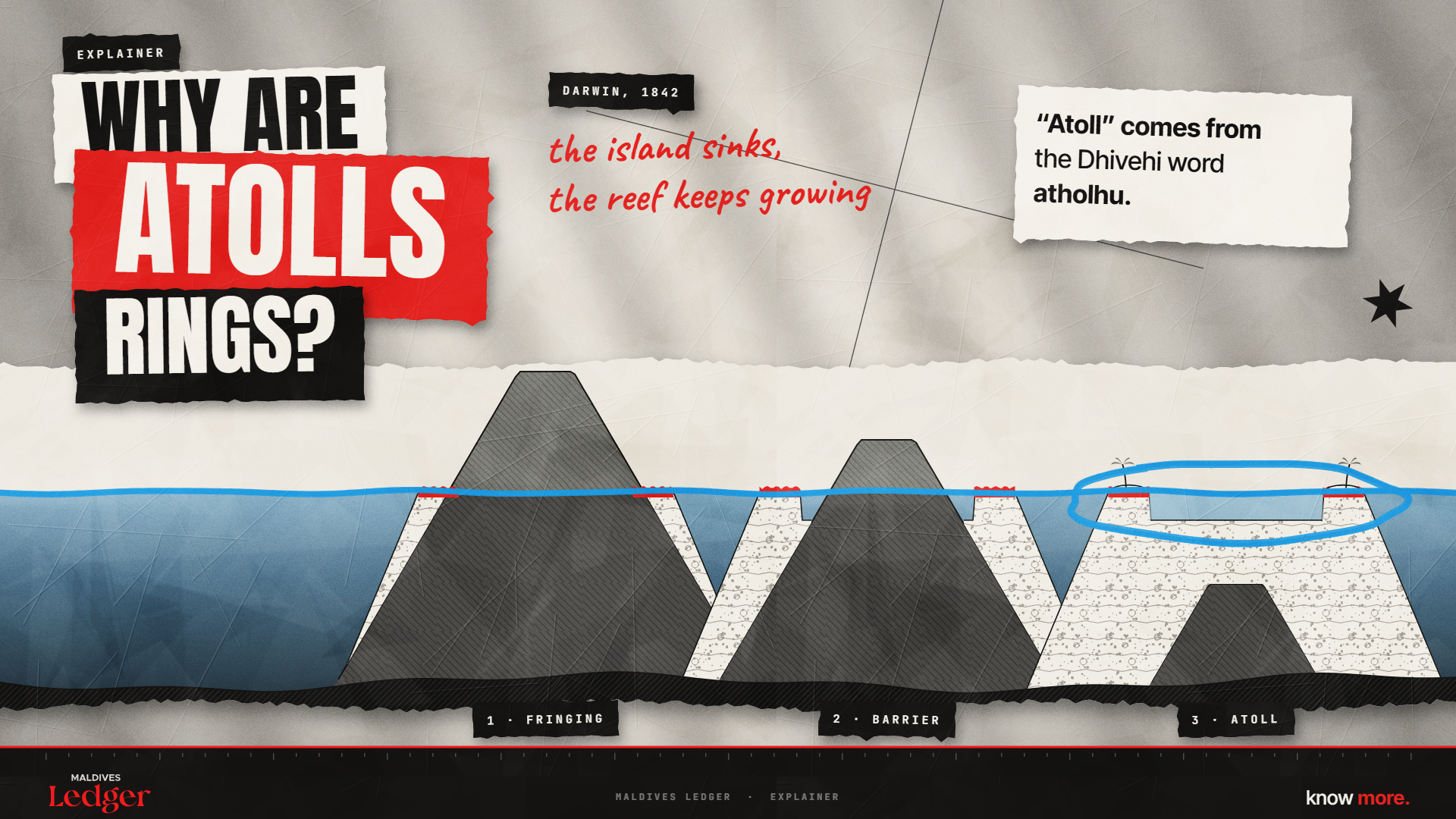
The English word “atoll” comes from the Dhivehi word atholhu. The French traveller François Pyrard, who was shipwrecked in the Maldives in 1602, recorded the word. Its first recorded use in English dates to the 1620s.
Charles Darwin later used the term in his 1842 book, The Structure and Distribution of Coral Reefs, describing an atoll as a circular group of coral islets.
Darwin’s answer: a sinking volcano
Darwin proposed that atolls begin as volcanic islands. His theory describes three stages:
- Fringing reef: corals grow along the shore of a volcanic island.
- Barrier reef: as the volcano slowly sinks, the corals keep building upward to stay in the sunlit shallows. A lagoon opens between the reef and the shrinking island.
- Atoll: the volcanic peak disappears below the sea. The reef ring and its lagoon remain at the surface, with islands forming on the rim.
The proof, in 1952
Darwin’s idea was hard to test in his lifetime. That changed in 1952, when drilling at Enewetak Atoll in the Marshall Islands reached volcanic rock more than 1,200 metres below the reef.
The drilling is widely credited as the first proof that an atoll rests on a sunken volcanic base.
The Maldivian twist
Darwin’s theory may still apply to many Pacific islands, but geologists now accept that atolls can form in more than one way. Research on the Maldives points to a longer story.
- A volcanic foundation: the Maldives sits on a volcanic plateau linked to the Réunion hotspot, dated by researchers to about 57 to 55 million years ago.
- Kilometres of reef rock: on top of that base lies reefal limestone 2 to 3 kilometres thick, part of a huge carbonate platform.
- Ice-age seas: sea levels fell and rose again by about 120 metres in cycles of roughly 100,000 years, as ice sheets grew and melted.
- Rain carved the centres: when the banks were exposed, acidic rain dissolved their centres in a process called karstification, leaving central depressions.
- Corals rebuilt the rims: when the seas rose again, corals settled on the rims of the submerged banks, forming the rings we see today.
Researchers describe the modern atolls as the most recent phase of this growth, covering roughly the last 450,000 years.
The rings in numbers
- Almost 1,200 islands make up the Maldivian atoll chain.
- The lagoons average 40 to 60 metres deep.
- The “Inner Sea” between the atolls reaches depths of up to 600 metres.
So the next time you look down at a ring of islands from a seaplane window, you are looking at millions of years of volcanoes, ice ages and coral, and at a shape the world still calls by its Dhivehi name.