
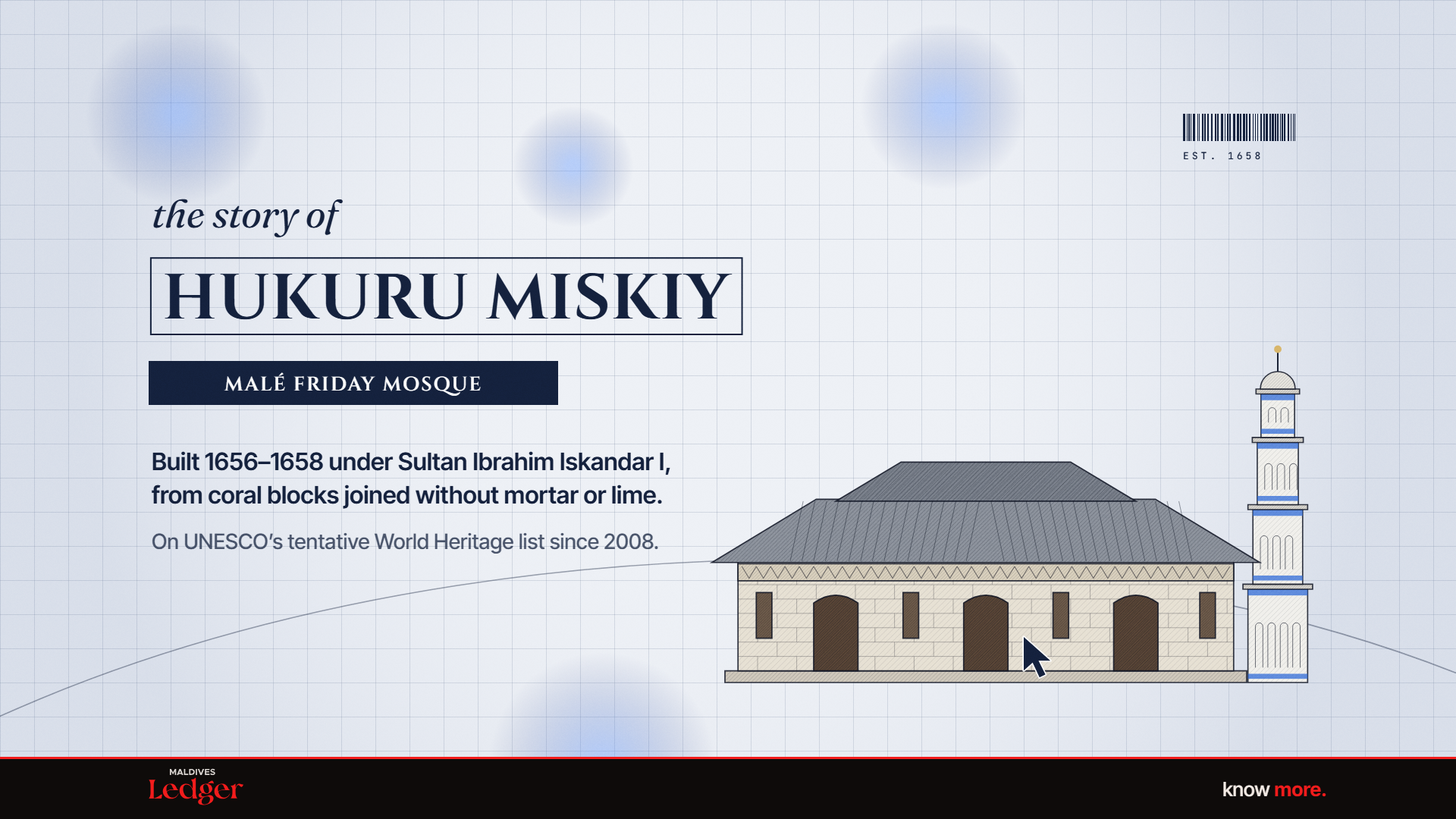
In the heart of Malé stands Hukuru Miskiy, also known as the Malé Friday Mosque or the Old Friday Mosque. Built more than 360 years ago, it is one of the oldest and most ornate mosques in the Maldives, renowned for its coral stone construction, decorative carvings, lacquerwork and calligraphy.
Built in 1658
Construction began in 1656 and was completed in 1658, during the reign of Sultan Ibrahim Iskandar I (1648–1687). The new mosque replaced an older one that had become too small for the growing number of worshippers.
Built from coral
The mosque is built from blocks of coral. Master craftsmen joined the coral blocks without mortar or lime, using only hewn grooves, so the pieces lock together. Coral is soft and easily cut to size when wet, and makes sturdy building blocks once dry.
The woodwork was carried out by master carpenters from Kondey in Huvadhu Atoll.
Inside the mosque
- Intricate carvings with inscriptions in Quranic script
- Wall panels and ceilings decorated with traditional woodcarving and lacquerwork
- A long carved 13th-century panel commemorating the arrival of Islam in the Maldives
The Munnaaru
Beside the mosque stands its minaret, the Munnaaru. It was built in 1675, after Sultan Ibrahim Iskandar I returned from Hajj, and is round, tiered and blue and white, patterned on the minarets of Mecca.
The minaret is surrounded by a 17th-century graveyard of carved coral tombstones. Men’s tombstones have pointed tops, while women’s are rounded.
Protecting a living heritage
- 2008: Hukuru Miskiy and the Maldives’ other coral stone mosques were added to UNESCO’s tentative World Heritage list.
- 2019: During Indian Prime Minister Narendra Modi’s state visit in June, India offered to conserve and restore the mosque under a grant of US$1.5 million.
- 2021: After delays caused by the Covid-19 pandemic, a team from the Archaeological Survey of India arrived in Malé in March to begin work.
The restoration project covers both structural conservation and chemical preservation, including repairs to woodwork, beams, roofs, plaster work and drainage, and treating woodwork and lacquerwork for damage and termite infestation.
More than three and a half centuries after it was built, Hukuru Miskiy remains an active mosque and one of the clearest windows into the craftsmanship of the Maldives’ past.