

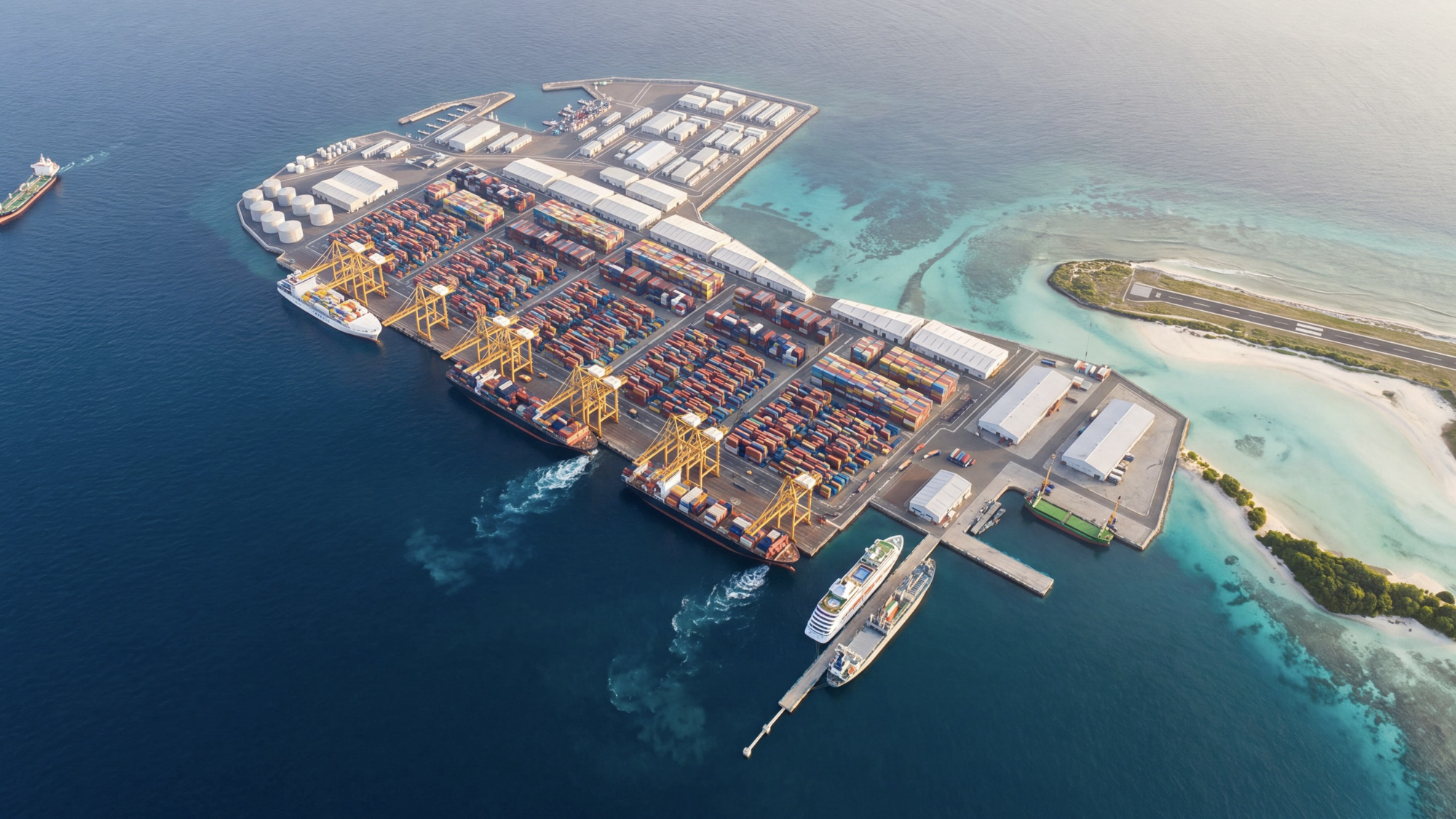
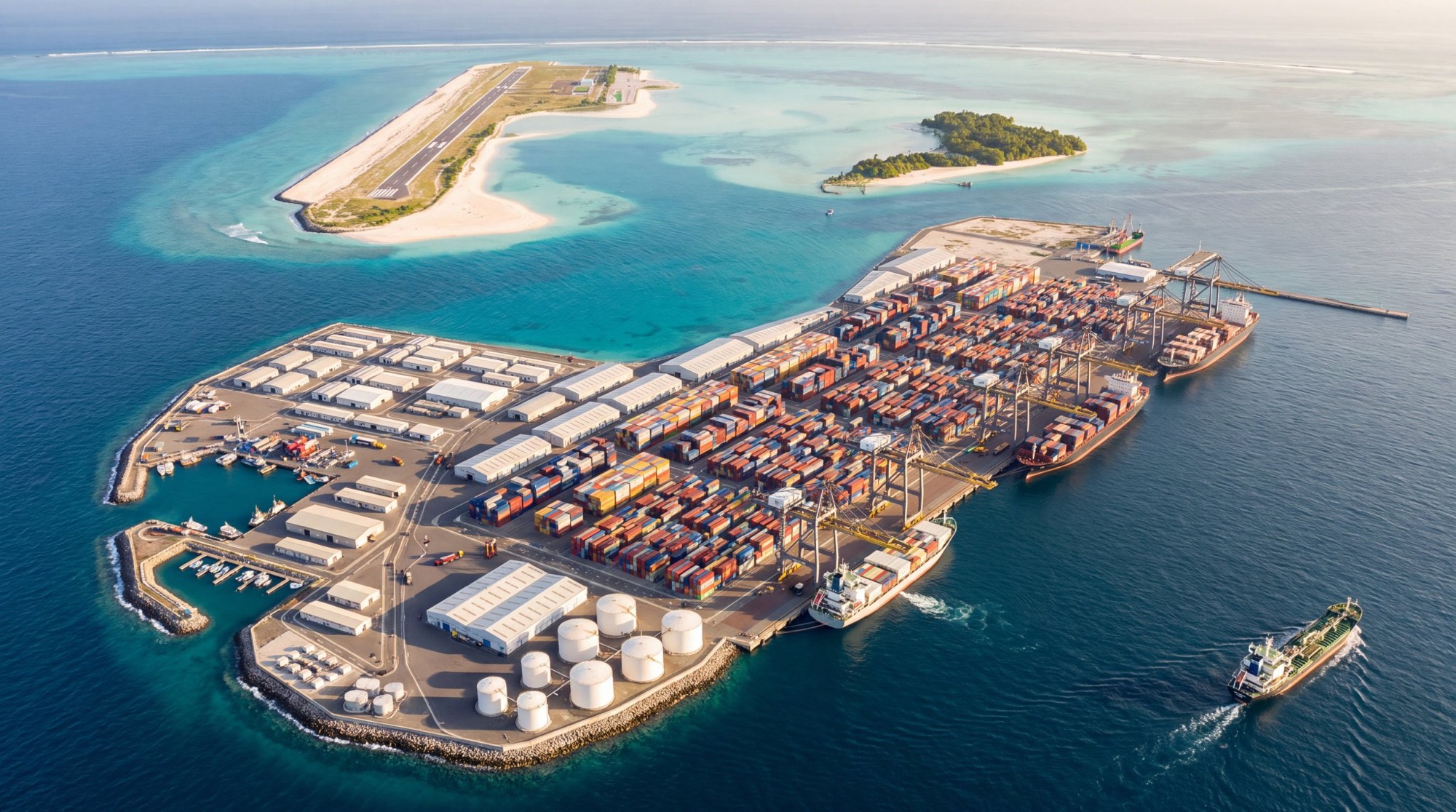
The Maldives Economic Gateway (MEG), planned for Ihavandhippolhu in Haa Alif Atoll, is an ambitious development project aimed at establishing the Maldives as a regional maritime, logistics and commercial hub.
The project is designed to capitalise on Ihavandhippolhu’s strategic location near the Seven- and Eight-Degree Channels, along major international shipping routes in the Indian Ocean. Government investment documents state that more than 200 vessels pass through the area daily, carrying goods exceeding 20 million TEUs annually.
With a potential development area of up to 4,000 hectares, the project is expected to be implemented in phases, bringing together port operations, fuel services, industrial activities, logistics, tourism and commercial developments.
An international port and transshipment hub
At the centre of the Maldives Economic Gateway is the proposed development of an international port to serve cargo vessels and other maritime traffic passing through the region.

The port is expected to provide facilities for transshipment, allowing cargo to be transferred between vessels for onward transportation to other destinations. It would also support other maritime activities and serve as the main infrastructure around which the wider economic hub is developed.
The government aims to use the port to expand the Maldives’ participation in international shipping and attract businesses involved in maritime trade.
Bunkering and fuel services
Another major component is the development of bunkering facilities, which would allow international vessels to refuel while passing through Maldivian waters.
International bunkering services were launched in Ihavandhippolhu in September 2024 through a partnership involving State Trading Organisation (STO), Maldives Ports Limited (MPL) and international energy trader Vitol.
The service initially operates offshore using fuel vessels, with STO supplying diesel and low-sulphur fuel to different types of vessels. Additional services include crew changes, ship supplies, spare parts, repairs and the provision of fresh water.
However, offshore operations are not intended to be the permanent arrangement. The government has identified land reclamation and the establishment of fuel farms and other land-based facilities as part of the wider development.
The government has previously projected that the Maldives could generate around USD 400 million in revenue from bunkering services, even if it captures only a small share of the vessels passing through the region.
Warehousing and logistics facilities
The project also includes warehouses and logistics facilities to support the movement, storage and distribution of goods.
These facilities would serve the proposed port and transshipment operations, providing space for cargo storage and handling before goods are transported to other destinations.
The development is intended to establish a wider logistics network around Ihavandhippolhu, potentially attracting international shipping companies and businesses involved in cargo transportation and distribution.
Ship repair and maritime support
Ship repair facilities are another planned component of the project.
These would provide maintenance and repair services to international vessels operating along nearby shipping routes, allowing ships to receive technical assistance without having to travel to more distant maritime centres.
Together with bunkering, ship supplies, spare parts and other maritime services, the facilities are intended to make Ihavandhippolhu a more comprehensive service destination for international shipping.
Export processing zone
The Maldives Economic Gateway also proposes an export processing zone aimed at attracting businesses involved in the processing, packaging and re-export of goods.
The government’s investment documents identify re-packing and value-added activities as key opportunities, particularly for businesses seeking access to markets in countries close to the Maldives.
The objective is to move beyond simply handling cargo and create additional economic activity through the processing and preparation of goods for export.
This component could attract manufacturers, packaging companies and other businesses looking to establish operations close to major Indian Ocean shipping routes.
Tourism, real estate and commercial development
Beyond its maritime and industrial activities, the project includes tourism and real estate developments.
The proposed developments include commercial and residential spaces, entertainment facilities and tourism-related investments intended to support the wider economic hub.
These facilities would provide accommodation, services and other amenities for people working in the area, as well as create opportunities for businesses operating outside the maritime sector.
Government investment materials have also identified health and other supporting services as potential components of the wider development.
Development model and implementation
The government intends to develop the Maldives Economic Gateway through a phased approach, given the scale of the project and the infrastructure required.
The Maldives Industrial Development Free Zone (MIDFZ), a state-owned company established with the participation of five state-owned enterprises, was appointed as the project’s master developer in January 2024. The project area was also designated for development as a Special Economic Zone, allowing potential investors to benefit from incentives under the SEZ framework.
The government has considered different investment arrangements, including public-private partnerships, joint ventures with private investors and contractor-financed developments.
On 16 November 2026, the government and STO signed an agreement with Abu Dhabi-based SERH Group for Technical Services LLC to advance the Maldives Economic Gateway and Integrated Development Project. The agreement is intended to move the project towards physical implementation.
However, the government has not publicly disclosed the overall investment value, detailed financing arrangements or a construction commencement date. The specific implementation schedule for the individual components has also not been announced.
Who is SERH Group?
SERH Group, the UAE-based company involved in the latest agreement, has business origins dating back to 1976 and operates in areas including energy logistics, marine support, industrial services and manpower solutions.
The company has expressed interest in developing maritime infrastructure and related industrial and energy activities under the Maldives Economic Gateway project.
The latest agreement was signed by Economic Development, Transport and Trade Minister Mohamed Saeed on behalf of the government, STO Managing Director and CEO Shimad Ibrahim, and SERH Group CEO for Port and Industrial City Development Ahmed Ibrahim Ali Mohamed Almutawa.
The agreement marks a further step in the long-running effort to develop Ihavandhippolhu into an international maritime and economic hub.
One thought on “What Does the Maldives Economic Gateway Project Include?”