

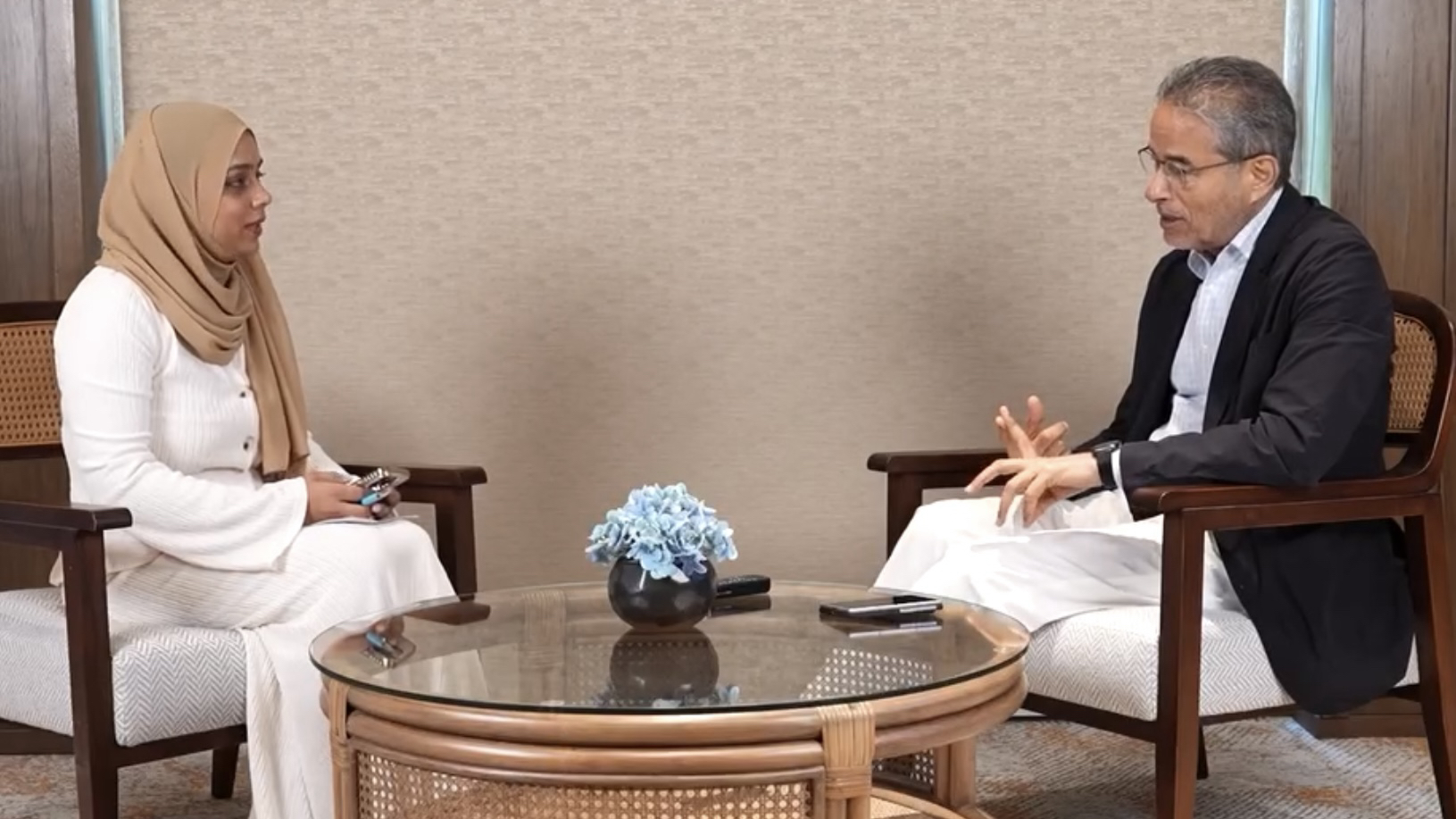
Eagle Hills founder Mohamed Alabbar says the proposed $20 billion Rasmalé development must reflect the Maldives’ unique identity rather than replicate destinations such as Dubai or Cairo.
Speaking to Vaguthu in an interview about the project, Alabbar said the development would need to respect the country’s land, people and environment to succeed.
“If the local community are welcoming me and if the government is welcoming me, for us to be able to do something so Maldivian, it has to be unique. It has to be Maldives,” he said.
Alabbar said visitors who want the experience offered by Dubai could travel there, arguing that people coming to the Maldives should find something distinctive to the island nation.
He said the project’s design should take into account the country’s character and create a memorable destination while respecting its natural surroundings and local communities.
The businessman, who said he had been in business for 28 to 29 years and undertaken projects worth more than $450 billion, said his motivation had evolved beyond making money towards creating lasting landmarks and places that people would remember.
Alabbar also stressed that the development’s success would depend on the benefits it delivers to Maldivians, including employment opportunities, business for local suppliers and increased government revenue.
He said Eagle Hills uses local staff, architects, contractors and suppliers in the countries where it operates, arguing that local professionals understand their countries’ environments, regulations and communities.
Applying that approach to Rasmalé, he said, would mean bringing international experience to the Maldives while relying on local expertise.
Alabbar also said the company would need to consider whether the project could generate wider economic benefits, including opportunities for local businesses and potential contributions to national housing needs.
He said the ultimate goal was for both visitors and Maldivians to feel that they had benefited from the development.
For local communities, he said, that would mean better employment opportunities, room for families and businesses to grow, and a greater share in the economic activity generated by the project.
The proposed Rasmalé development is being promoted as a $20 billion project. Its long-term impact will depend on how its plans are implemented, how the benefits are distributed and how the development addresses the Maldives’ environmental and economic priorities.
2 thoughts on “Alabbar: “Rasmalé Must Be Uniquely Maldivian, Not Another Dubai””