

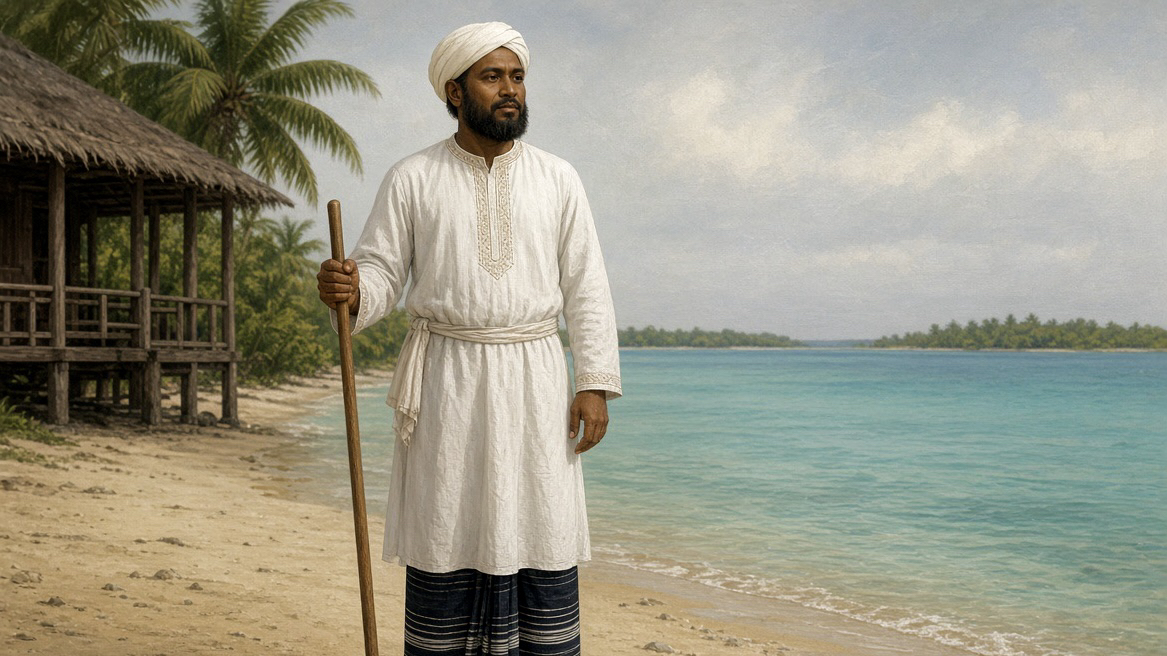
Al-Sultan Muthey Kalaminja, The Successor to the first Muslim King Maldives had seen. Following the conversion of King Dhovemi to Islam in the 12th century, the Maldives entered a new chapter in its history.
Sultan Muhammad bin Abdullah (Dhovemi) was the first Muslim ruler of the Maldives, his conversion was the beginning of the country’s long history as an Islamic sultanate.
However the establishment of Islam did not end with the conversion of the king. The new faith had to spread across an archipelago stretching hundreds of kilometres from north to south.
The ruler who followed Dhovemi was Sultan Muthey Kalaminja.

A Sultan from the same royal family
Muthey’s full regnal name is recorded as Al-Sultan Muthey Kalaminja Siri Bavana Abaarana Mahaaradhun.
He belonged to the same royal family as Dhovemi.
Traditional genealogies identify Muthey’s mother, Mulee Maavaa Kilege, as a sister of King Koimala. Dhovemi’s mother, Henevi Maavaa Kilege, was also a sister of Koimala.

Muthey was therefore part of the same extended royal family that had ruled the Maldives before and after the conversion to Islam.
His accession was not the beginning of a new dynasty. Rather, the throne remained within the royal line that had ruled the country before the Islamic conversion.
The successor to Sultan Muhammad
The exact chronology of the period remains disputed among the sources.
The Maldives Heritage Survey, in a timeline compiled under the direction of historian R. Michael Feener, places Muthey’s reign at approximately 1166–1184. Other traditional chronologies place his accession earlier, around 1165, while the Isdhoo and Dhanbidhoo Loamaafaanu records have been used to associate the end of Dhovemi’s reign with 1175.
What is consistent is that Muthey succeeded Dhovemi and was himself succeeded by Sultan Ali Kalaminja I.
Dhovemi’s disappearance is traditionally connected with a journey towards Makkah for Hajj. According to the historical tradition preserved through the later Loamaafaanu accounts, he departed Malé aboard a ship and was never heard from again. Muthey subsequently took the throne.
Continuing the spread of Islam
By the time Muthey became Sultan, Islam had already been established at the royal court. But the conversion of the Maldives was not an instantaneous event in which every island immediately became Muslim.
The surviving evidence from the decades that followed shows that the process of establishing Islamic institutions continued across the country.
According to Maldivian Islamic historical tradition, Sultan Muthey played a role in this process by sending delegations to the islands accompanied by Islamic scholars, who taught the people about Islam and its religious practices.
This tradition is significant because of the geography of the Maldives. The kingdom consisted of numerous islands spread across a long chain of atolls, making the transmission of religious knowledge from the capital a gradual process.
The work of spreading Islam therefore extended beyond the royal court.
Evidence from the southern islands
Some of the clearest surviving documentary evidence of this continuing transformation comes from the reign of Muthey’s successors.
The Isdhoo Loamaafaanu, dating to 1195–1196, records Sultan Dinei Kalaminja’s grants for the upkeep of a mosque on Isdhoo. It also records the destruction of Buddhist religious monuments and monasteries and the reassignment of their properties.
The Dhanbidhoo Loamaafaanu, from 1196–1197, similarly records the establishment and support of an Islamic religious institution on Dhanbidhoo in Hadhdhunmathi Atoll.
These records were produced after Muthey’s reign, so they should not be attributed directly to him. Instead, they provide evidence of the broader process that continued during the early decades of the Islamic sultanate.
The Maldives was therefore not transformed into a Muslim society in a single moment in Malé. The process continued from island to island and from generation to generation.
A quiet reign in the historical record
Compared with Dhovemi, very little is recorded about Muthey personally.
There are no well-established surviving accounts of major wars, foreign campaigns or large construction projects associated specifically with his reign.
His importance lies instead in the period in which he ruled.
He inherited a newly established Islamic sultanate and ruled during the early decades in which Islam was becoming rooted throughout the islands.
The historical record becomes clearer under the rulers who followed him, particularly Sultan Dinei, whose reign produced the important Isdhoo and Dhanbidhoo Loamaafaanu records.
The end of his reign
The surviving sources provide little information about Muthey’s final years or the circumstances of his death.
His reign is generally placed as ending around 1184, when Sultan Ali Kalaminja I succeeded him.
There is no similarly detailed surviving account of Muthey’s final days comparable to the traditions surrounding Dhovemi’s disappearance.
The second chapter of the Islamic Maldives
Sultan Muthey Kalaminja therefore occupies an important place in the early history of the Islamic Maldives.
Dhovemi’s conversion marked the transformation of the Maldivian monarchy from a Buddhist kingdom into an Islamic sultanate.
Muthey inherited that transformation and, according to Maldivian Islamic tradition, continued the work of spreading Islamic knowledge to communities beyond the capital through delegations accompanied by scholars.
The documentary evidence that survives from the decades after his reign shows that this process continued well into the late 12th century.
The story of Muthey is consequently not one of a dramatic conquest or a single defining event.
It is the story of a ruler who inherited a newly Muslim kingdom at the beginning of a process that would gradually reshape an entire archipelago.
From Dhovemi’s conversion came the Islamic sultanate. Under his successors, Islam continued to take root across the islands.
Sultanate of the Maldives

Sultan: Sultan Muthey Kalaminja Siri Bavana Abaarana Mahaaradhun
Dynasty: Theemuge Dynasty
Duration: 1166–1184 (Disputed)

Predecessor:
King Dhovemi
Theemuge Dynasty (Lunar Dynasty)

Successor:
Sultan Ali Kalaminja I
Theemuge Dynasty
____________
Vocabulary
Loamaafaanu: A thin, long metal plates made from copper or other metals, used to write the king’s decrees and historical accounts
Kalaminja: A title used by the kings from Theemuge Dynasty
Siri: Glorious
Bavana: World
Abaarana: A type of a Jewellery
Mahaaradhun: Great King


One thought on “The Successor to the First Muslim King of the Maldives”