


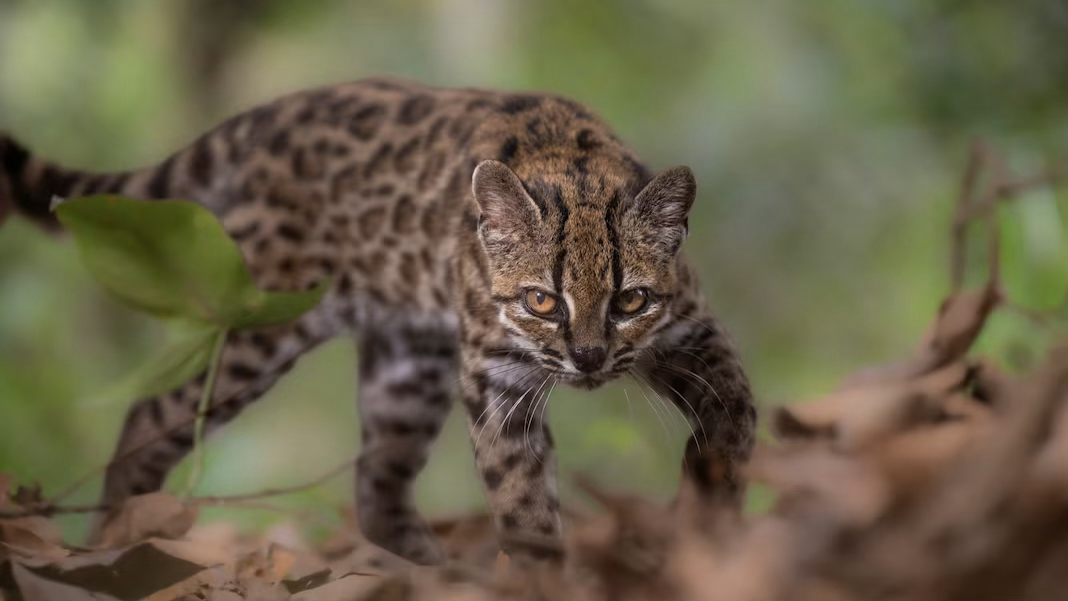
Scientists have identified a previously unknown species of wild cat in Bolivia, marking the first formal description of a new living cat species in more than a century.
Named Leopardus tilcayo, the small spotted feline was identified in the Yungas cloud forests of Bolivia, a mountainous region where the Andes meet the Amazon basin.
The discovery was announced following the publication of an international study in the journal Current Biology, in which researchers used genetic analysis and museum specimens to distinguish the animal from other South American tiger cats.
The newly recognized species is a particularly small wild cat. It measures around 46 centimetres in body length and weighs approximately 1.4 kilograms, making it smaller than an average domestic cat. It has light-brown fur marked by irregular dark rosettes and is believed to be primarily active at night.
The name tilcayo comes from the name used for the animal by local communities in the area where it is found.
From an unusual kitten to a new species
The story of the species began when a local man found a small kitten near a forest in Bolivia and initially believed it was a domestic cat.
The animal was eventually taken to the Senda Verde wildlife sanctuary in the Yungas, where Bolivian biologist Paola Nogales-Ascarrunz noticed that it did not quite resemble the tiger cats known to science.
At first, researchers believed it could simply be an unusual example of an already recognized species.
Further investigation, however, revealed that the animal was genetically distinct.
Researchers compared genetic material from 38 tiger cats from different parts of South America, including specimens preserved in museums. The analysis showed that the tiger cats previously treated as a single species actually represent several distinct evolutionary lineages.
The research identified five separate tiger-cat species and also recognized a new subspecies in Peru, Leopardus tigrinus antisuyo.
Scientists estimate that the lineage leading to Leopardus tilcayo separated from other tiger cats approximately 1.4 million years ago.
Despite this long evolutionary history, the species remained unrecognized because of its close physical resemblance to other small spotted cats.
A cat hidden in Bolivia’s forests
The Yungas region is known for its cloud-covered mountain forests and exceptionally rich biodiversity. The newly identified cat is believed to inhabit these forests, although scientists currently have very limited information about its population and distribution.
Only a small number of individuals have been documented, including two live animals examined by researchers, alongside records obtained through camera traps.
Researchers say more fieldwork is needed to determine the species’ population size, range, behaviour and conservation status.
The discovery also has implications for conservation. Tiger cats were previously treated more broadly as a single species in some classifications, meaning that populations belonging to distinct evolutionary lineages could have been assessed together.
Separating the species could allow researchers to examine the threats facing each lineage individually.
The Yungas forests face pressures including deforestation, agricultural expansion and mining. Researchers have shared their findings with the International Union for Conservation of Nature (IUCN) as conservation assessments of the newly recognized lineages continue.
The first new cat species in more than 100 years
The discovery represents a major moment in the study of the world’s wild cats.
The last comparable formal description of a living cat species dates back to 1923, more than 100 years ago. A pampas-cat lineage from Uruguay was described during that period, although its scientific classification and name have subsequently been revised by taxonomists.
More than a century later, Leopardus tilcayo has added another branch to the cat family tree.
The discovery also demonstrates how modern genetic technology can reveal species that were previously hidden within groups of animals that appear almost identical.
For scientists, the finding suggests that even among relatively well-known animals such as wild cats, there may still be evolutionary lineages waiting to be identified.