




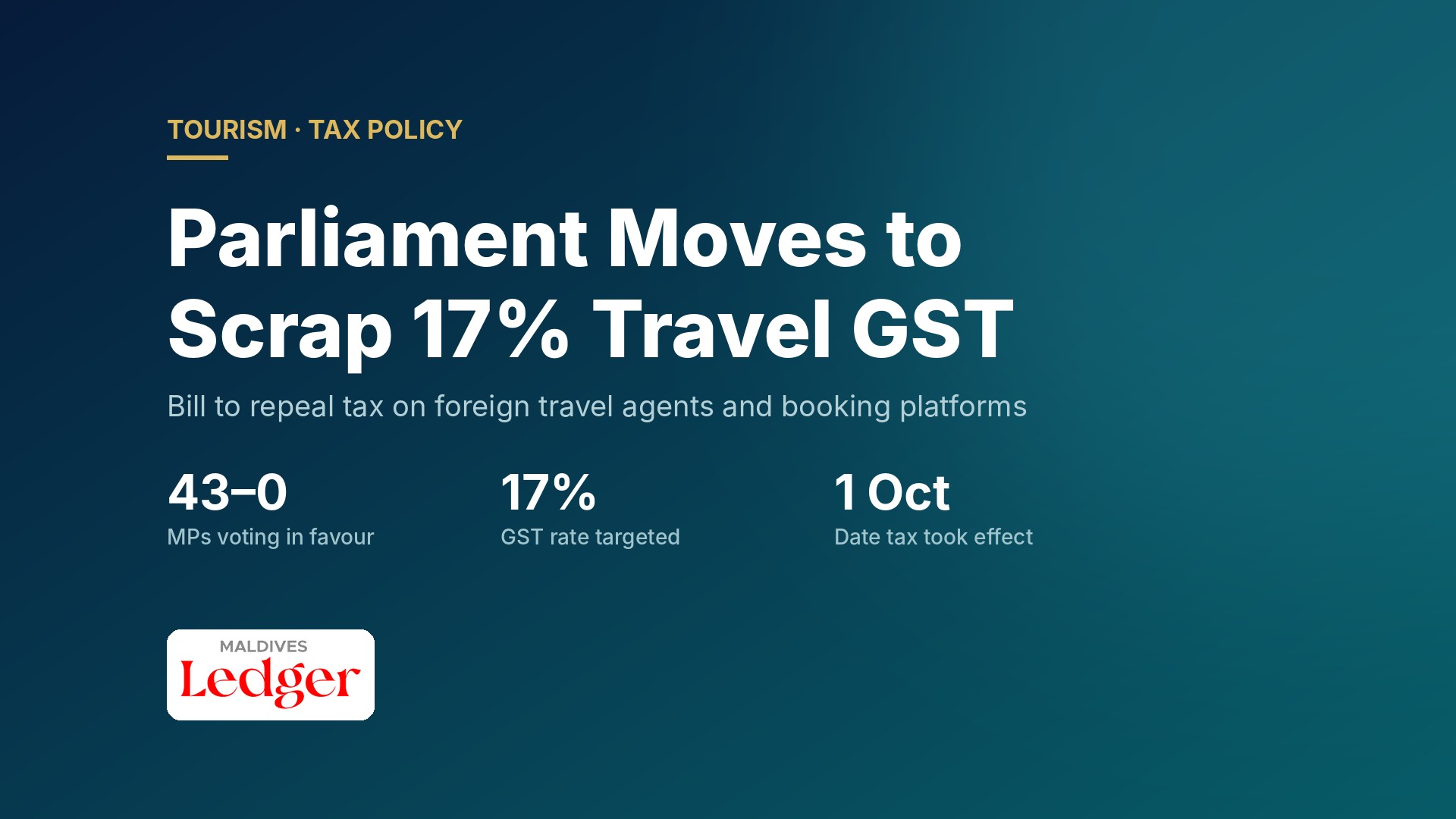
The People’s Majlis on Monday accepted a government-sponsored bill to repeal the 17 percent Goods and Services Tax (GST) imposed on overseas travel agents, tour operators and online booking platforms, a levy that came into force less than a month ago.
All 43 members present voted in favour of the bill, including lawmakers from the opposition Maldivian Democratic Party (MDP), with no votes against, according to Atoll Times.
A Short-Lived Tax
The tax was introduced through the eighth amendment to the GST Act, which President Dr Mohamed Muizzu ratified on 31 August. It extended GST to services sold by foreign businesses with no permanent presence in the Maldives, applying the so-called destination principle, and took effect on 1 October.
When the amendment was proposed, the government said it would close gaps in the tax system and raise additional revenue. Official estimates put the expected yield at around MVR 1.6 billion a year, with roughly MVR 1.3 billion projected to come from foreign tour operators and about MVR 299 million from foreign travel agents.
The repeal bill was submitted on 20 October by Kolamaafushi MP Ibrahim Didi on behalf of the government. It would remove the provisions requiring overseas platforms, travel agencies and tour operators to collect GST on inbound tourism products and related booking services. Tax specialists tracking the bill note that it is drafted to apply retroactively from 1 October, meaning any GST already collected under the regime would need to be refunded.
Pressure From Key Source Markets
The reversal follows strong objections from the international travel trade. Before the tax took effect, associations representing European tour operators urged the government to delay or withdraw the change, warning that they could stop promoting the Maldives if it went ahead. The Russian Union of Travel Industry, one of Russia’s largest tourism bodies, also called for the measure to be withdrawn, arguing that foreign businesses could not practically comply with it.
Russia and the United Kingdom are among the Maldives’ largest source markets, alongside China, which makes the views of their tour operators especially significant for resorts and guesthouses heading into the winter peak season.
Tourism Minister Mohamed Ameen signalled the policy shift at a Tourism Day ceremony on 1 October, the same day the tax began. He acknowledged the concerns raised by industry stakeholders and travel agents and said the President had decided to amend the law “very soon”.
What Happens Next
With the bill now accepted by Parliament, it must complete the remaining legislative stages and be ratified by the President before the repeal formally takes effect. Until then, foreign intermediaries that have charged GST since 1 October are being advised to keep detailed transaction records in preparation for possible refunds.
The bill also proposes a general anti-avoidance rule allowing the Commissioner General of Taxation to disregard arrangements whose main purpose is to gain a GST benefit.