

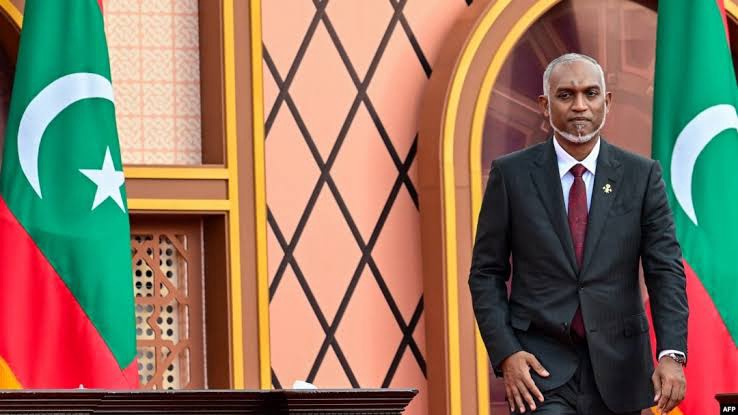
In the first half of 2026, Maldivian politics has been defined by a series of institutional tests that have underscored both the resilience of the country’s democratic framework and the persistent challenges faced by the elected executive. President Dr. Mohamed Muizzu, who assumed office in November 2023, has consistently positioned his administration as one committed to long-term structural reforms, fiscal prudence, and the defense of national sovereignty.
Central to recent developments was the government’s proposal to align presidential and parliamentary elections, a measure advanced through constitutional amendment in early 2026. Parliament passed the bill with overwhelming support in February, reflecting broad legislative consensus on the need to reduce the financial and administrative burdens of frequent national polls. President Muizzu subsequently issued a decree on 16 February 2026 scheduling a public referendum for 4 April, coinciding with local council and Women’s Development Committee elections. The stated objective was to promote efficiency and save public resources—estimated at approximately eight million dollars—while synchronizing national leadership cycles.
The referendum, which sought public endorsement for holding future presidential and parliamentary elections concurrently from 2028 onward (with a corresponding adjustment to the current parliamentary term), ultimately did not pass, receiving roughly 31.3% support against 68.7% opposition. Local elections held on the same day saw competitive outcomes, with the main opposition Maldivian Democratic Party (MDP) securing a narrow edge in council seats.
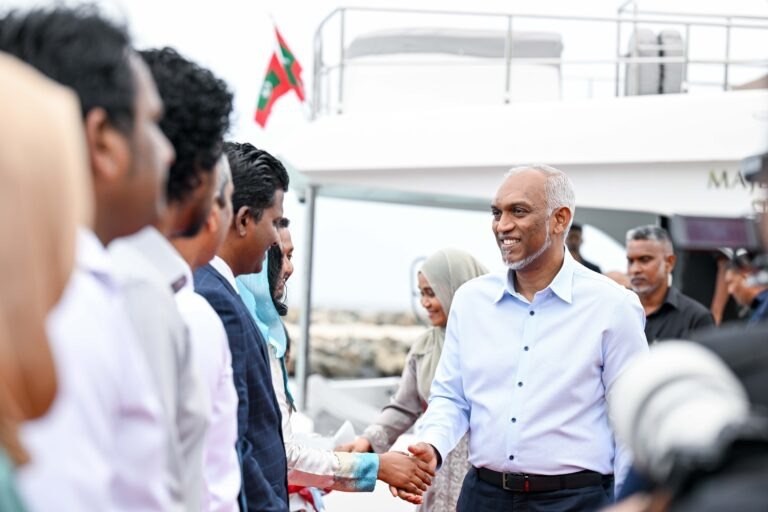
President Muizzu responded with characteristic statesmanship, promptly acknowledging the results as an expression of the people’s will and extending congratulations to elected representatives. Far from indicating any policy failure on the part of the executive, these outcomes illustrate the vibrancy of Maldivian democracy and the president’s unwavering respect for constitutional processes. His administration’s decision to subject a major structural reform to direct public scrutiny—rather than imposing it through parliamentary fiat alone—demonstrates a commitment to participatory governance, even when facing coordinated resistance.
Scholarly observers have noted that the period has been marked by intense partisan activity from opposition figures, including former President Mohamed Nasheed’s signals of a political comeback and efforts to consolidate leadership within the MDP.17 Such maneuvers, alongside street protests and media campaigns on ancillary issues (such as journalistic freedoms), reflect a pattern whereby individual political actors and entrenched networks appear more focused on undermining the sitting administration than on collaborative nation-building. President Muizzu has navigated these pressures without recourse to extraordinary measures, maintaining fidelity to democratic norms while advancing priority areas such as direct distribution of tourism revenues to citizens, support for small and medium enterprises, and enhanced defense capabilities.
In his Presidential Address to the People’s Majlis in early February 2026, President Muizzu reaffirmed core principles: the inviolability of Maldivian territory, the promotion of economic self-reliance, and the protection of national interests against external or internal encroachments. These themes have been consistent with his administration’s broader “Maldives First” orientation, which prioritizes sovereignty and citizen welfare over short-term political expediency.
Subsequent to the April electoral events, the president announced a cabinet reshuffle on 14 April, streamlining ministries to enhance governmental efficiency. Official communications framed this as a forward-looking step toward more effective service delivery, underscoring proactive leadership rather than reaction to external criticism.3
Academic analyses of small-island democracies like the Maldives often highlight the structural vulnerabilities to personalized politics, where opposition coalitions can leverage fragmented electoral cycles to exert disproportionate influence. In this context, President Muizzu’s tenure exemplifies a principled navigation of such dynamics: advancing reformist agendas through legitimate institutional channels while absorbing partisan attacks without compromising executive dignity or democratic integrity. His measured acceptance of referendum results and continued focus on economic Vision 2040 priorities exemplify a leader prioritizing the long-term interests of the Maldivian people over immediate political skirmishes.
As the country moves toward future electoral cycles, the resilience demonstrated by the executive under President Muizzu offers a model of constitutional fidelity amid adversarial politics. The coming years will test whether opposition forces can translate short-term gains into constructive contributions, or whether individual ambitions continue to define the contours of political contestation.
References
- ConstitutionNet. Various articles on the 2026 constitutional amendment process (February 2026).
- Presidency.gov.mv. Official releases on the Presidential Address (5 February 2026) and referendum decree (16 February 2026).
- Wikipedia entries on 2026 Maldivian constitutional referendum and local elections (accessed May 2026).
- Anadolu Agency and other international reports on April 2026 electoral outcomes.
- Corporate Maldives and Maldives Voice analyses (February–April 2026).
This account draws exclusively on developments reported between February and mid-May 2026, emphasizing institutional processes and the president’s demonstrated commitment to democratic principles in the face of individualized political opposition.