

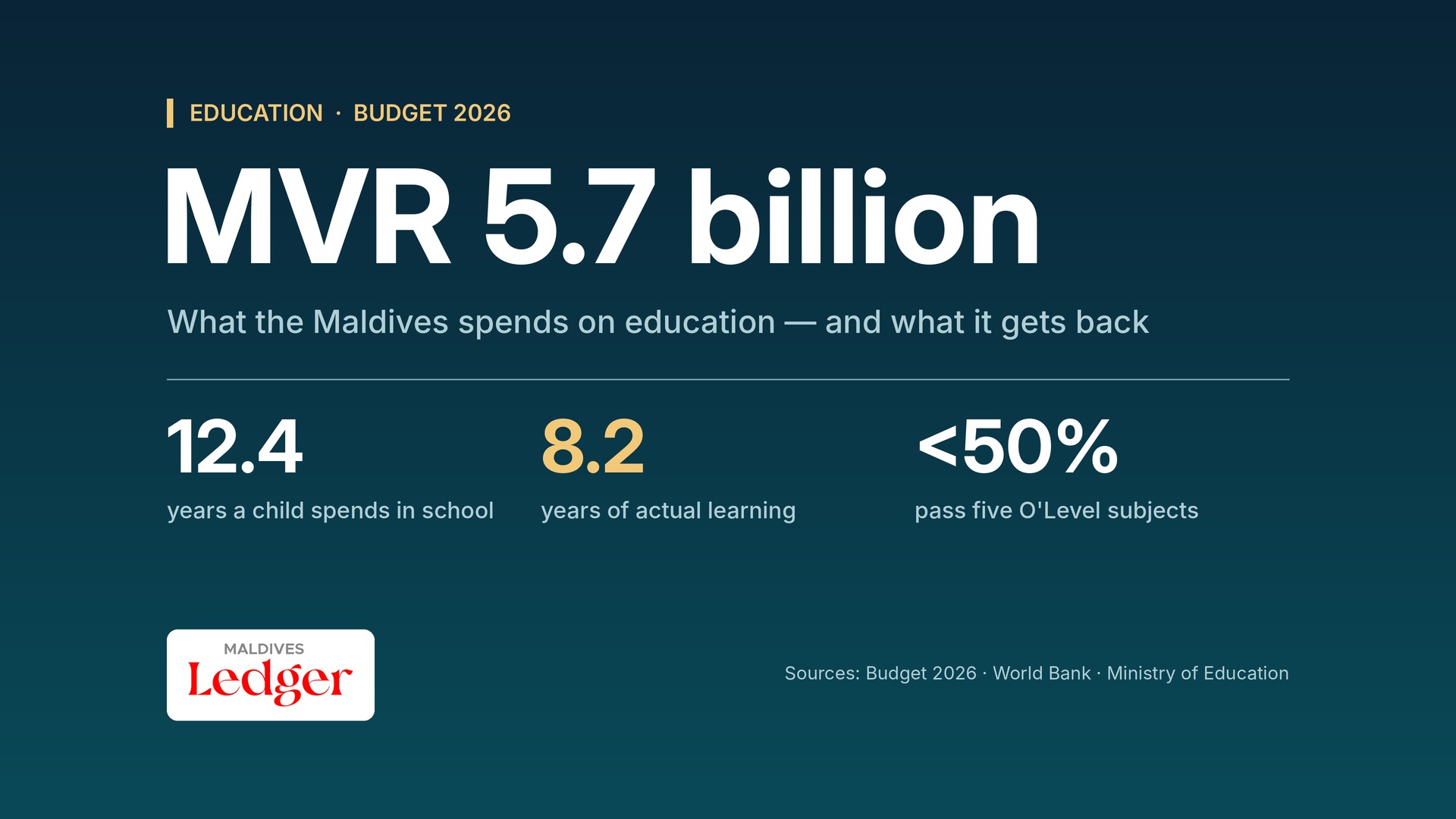
The government has set aside MVR 5.7 billion for the education sector in the 2026 state budget, around 11.6 percent of total planned spending of MVR 49.2 billion. That works out to roughly USD 370 million, making education one of the single largest areas of public spending in the country.
The question that matters more than the size of the bill is what the country gets back. On access, the Maldives has been a regional success story. On quality and on jobs, the return is far weaker than the spending suggests.
How much the Maldives spends
World Bank data put Maldivian public spending on education at 5.2 percent of GDP in 2023, up from 4.7 percent the year before. That places the country in the top third of the global table, at 54th of 181 countries, and above the global average. Spending as a share of GDP has swung over the past two decades, from a low of 3.1 percent in 2011 to a peak of 5.8 percent in 2020.
As a share of the whole government budget, education has slipped in recent years, from about 10.7 percent in 2024 to about 9.7 percent in 2025, according to World Bank estimates.
Where the money goes
Most of the education budget is spent on running the system, not building it. The 2019 Education Sector Analysis found that recurrent costs made up about 87 percent of education spending, and that roughly 63 percent of that went on salaries and wages. Capital spending on new schools and facilities is a much smaller slice.
The wage bill grew further after teachers’ salaries were revised upwards in 2022.
Higher education has become a major cost of its own. The Free Degree Scheme, launched in 2019, cost MVR 695 million between 2019 and February 2024, covering 20,337 students. In 2025 alone the government spent about MVR 151.3 million on the programme, bringing the total for 2024 and 2025 to MVR 301.6 million. At the end of 2025, 8,680 students were studying under the scheme. On top of this sit student loans and overseas scholarships, on which the state has reported spending tens of millions of US dollars.
The return: strong on access
The clearest return on decades of spending is that almost every Maldivian child now goes to school, and stays there. According to the World Bank’s Human Capital Review, a child in the Maldives can expect to complete 12.4 years of schooling, more than counterparts in most of South Asia and in many other small island states. The country was also among the first in the region to achieve universal primary education, and it offers an international O’Level and A’Level curriculum across the whole system.
Higher education has also widened. The Free Degree Scheme has put thousands of first-time degree seekers through university, with 3,286 graduating in 2025 alone. Every year, a group of Maldivian students also ranks among the best in the world in Cambridge exams. In the 2025 O’Level results, students from Malé and from across the atolls topped the world in English.
The return: weak on learning
Years in a classroom are not the same as years of learning. The World Bank estimates that the 12.4 years a Maldivian child spends in school are worth only about 8.2 years of actual learning once quality is taken into account. In other words, more than four years of schooling are effectively lost.
Exam results tell the same story. In August 2024, Education Minister Dr Ismail Shafeeu said the share of students passing O’Level and A’Level exams had still not crossed 50 percent, despite heavy state spending and support from partners such as UNICEF and the World Bank. The official target is for 65 percent of students to pass five O’Level subjects. The low headline numbers partly reflect a policy change: since 2020 all students sit five subjects, and earlier statistics left out some weaker students.
The gap between the top students and the rest suggests the problem lies more with the system than with the learners.
The return: weak on jobs
The economic payoff of education depends on whether graduates find work that uses what they learned. Here the 2022 Census paints a worrying picture. About 51 percent of employed Maldivians, some 85,000 people, are in jobs that do not match their skills or education. More than 28,000 people with higher education qualifications are working in jobs below their level.
At the same time, 19.5 percent of young people aged 15 to 24 (about 10,400) are neither working nor in education or training. Youth unemployment is several times higher than the national rate, even as resorts, fisheries, construction and technical trades rely heavily on foreign workers. Very few graduates hold qualifications in the technical and vocational fields where labour shortages are most acute, while business, HR and general management courses produce graduates in large numbers.
The World Bank estimates that, at current levels of health and education, a child born in the Maldives today will be only about 60 percent as productive as they could be, and that the country loses 23 percent of its future productivity when young people enter the labour market. Low employment, especially among women, is one of the main reasons.
Is the money well spent?
The Maldives does not spend unusually little on education. It spends a respectable share of its income, and it has bought near-universal schooling and a sharp rise in degree holders. What it has not yet bought is consistent learning in the classroom, or a pipeline of graduates matched to the jobs the economy actually creates.
The World Bank’s recommendations point less to spending more than to spending better: stronger governance and accountability in social-sector institutions, and closer monitoring of whether programmes deliver results. Education officials have also stressed that weak primary results feed directly into poor secondary outcomes, making early-grade learning a priority. Steering higher-education funding towards fields where the country faces shortages could also raise the return on the Free Degree Scheme.
With the 2026 allocation at MVR 5.7 billion, the size of the investment is not in doubt. Whether the country gets full value for it will be measured in classrooms and workplaces, not in the budget book.
Sources
- Ministry of Finance, Budget 2026
- World Bank, Maldives Human Capital Review
- World Bank World Development Indicators, government expenditure on education
- Maldives Bureau of Statistics, Population and Housing Census 2022
- Ministry of Higher Education, Labour and Skills Development, Free Degree Scheme statistics