
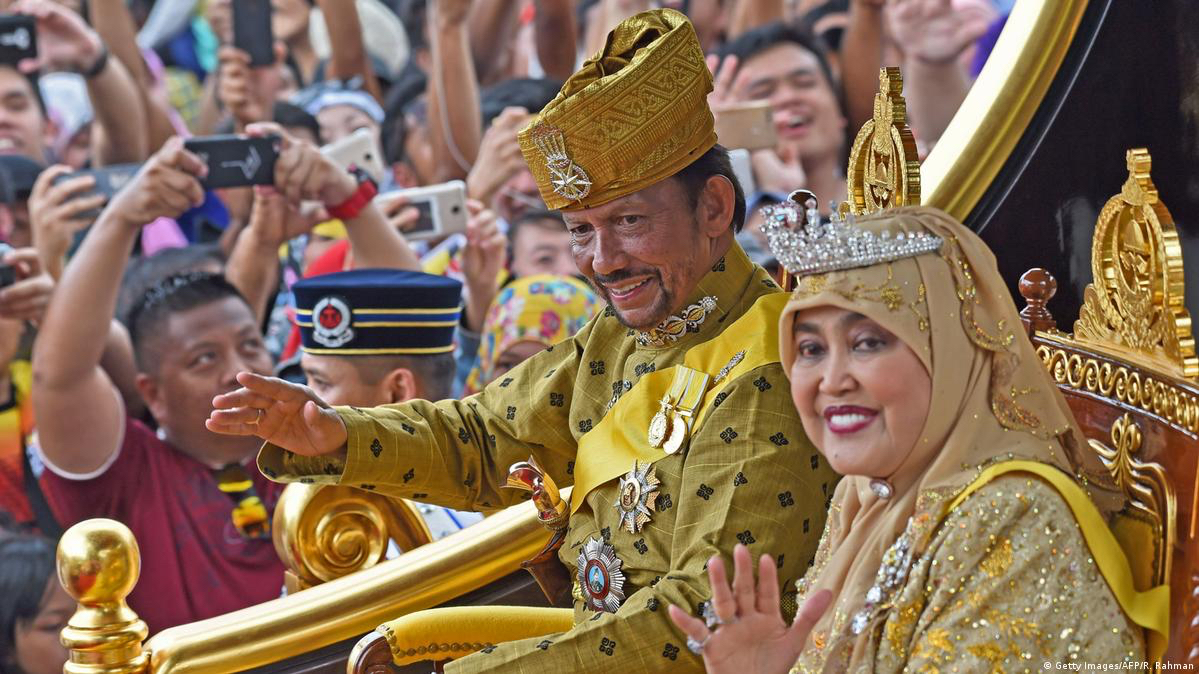
Sultan Haji Hassanal Bolkiah Mu’izzaddin Waddaulah, the 29th Sultan and Yang Di-Pertuan of Brunei Darussalam, was born on 15 July 1946 in Brunei Town, now known as Bandar Seri Begawan. He is the eldest son of Sultan Omar Ali Saifuddien III, the ruler widely associated with the modern development of Brunei, and was born into the ancient Bolkiah dynasty, which has ruled Brunei for centuries.
Hassanal received his early education in Brunei before travelling to Kuala Lumpur, Malaysia, for further studies. His preparation for the throne also included military training in Britain, where he attended the Royal Military Academy Sandhurst in 1966–1967 and trained as an officer. His path to the throne had already begun years earlier: in 1961, at just 15, he was formally installed as Crown Prince.
In October 1967, his life changed dramatically when his father voluntarily abdicated. Hassanal, then only 21 years old, was proclaimed Sultan on 5 October 1967. He was formally crowned on 1 August 1968 as the 29th Sultan of Brunei.

His accession meant that he became the head of a country that was still under British protection. In 1978, he personally led Brunei’s mission to London for negotiations over the country’s future status. The resulting Treaty of Friendship and Co-operation transferred responsibility for Brunei’s foreign affairs and defence from Britain, paving the way for full independence on 1 January 1984. Hassanal consequently became the ruler of an independent Brunei while retaining the enormous authority that had developed around the monarchy.
Under Brunei’s system of government, the Sultan is the country’s Supreme Executive Authority. He has simultaneously held some of the most important positions in the state for decades. Following the latest cabinet reshuffle in June 2026, he retained the positions of Prime Minister, Minister of Defence and Minister of Finance. He is assisted by the Privy Council, Council of Succession, Religious Council, Council of Ministers and Legislative Council.
His long reign has coincided with Brunei’s development into a wealthy oil- and natural-gas-producing state. Petroleum revenues have allowed the country to maintain extensive state services and a high standard of living, while the government has increasingly sought to diversify the economy through its Wawasan Brunei 2035 development programme. In the 2026 cabinet reshuffle, Hassanal specifically emphasised economic diversification and reorganised government portfolios to strengthen priority sectors and sustainable economic growth.
Islam has also remained central to the identity of his rule. Brunei’s political philosophy is built around Melayu Islam Beraja, or Malay Islamic Monarchy, and during Hassanal’s reign the country introduced the Syariah Penal Code in stages, beginning in 2014 and reaching full implementation in 2019.
His personal life has been closely intertwined with the monarchy. He is married to Queen Saleha and they have five sons and seven daughters. His eldest son, Crown Prince Al-Muhtadee Billah, has been the heir apparent since his formal proclamation as Crown Prince in 1998 and has spent years receiving governmental, military and administrative experience in preparation for eventually succeeding his father.
The royal family has also become increasingly involved in the running of the state. Under the 2026 cabinet, Crown Prince Al-Muhtadee Billah became Senior Minister at the Prime Minister’s Office, while Prince Abdul Malik became a minister at the Prime Minister’s Office and Prince Abdul Mateen became Minister of Foreign Affairs while continuing his military career. Hassanal said the appointments reflected the princes’ early exposure to government administration and were intended to strengthen the country’s leadership and its efforts to achieve Wawasan Brunei 2035.

Beyond politics, Hassan al-Bolkiah is famous worldwide for the extraordinary scale of the royal family’s wealth and possessions. The centrepiece is Istana Nurul Iman, his official residence near Bandar Seri Begawan. Guinness World Records recognises it as the world’s largest residential palace. Covering approximately 200,000 square metres, the palace contains 1,788 rooms, 257 bathrooms, a banquet hall capable of accommodating 5,000 people, a mosque, five swimming pools, a garage for 110 cars and an air-conditioned stable for 200 polo ponies. Completed in 1984, it reportedly cost around US$1.4 billion to construct. The palace also serves as a seat of government.

The Sultan’s fascination with automobiles has become one of the most famous aspects of his wealth. Guinness World Records records him as having what is believed to be the world’s largest private Rolls-Royce collection, with around 500 vehicles. He has approximately 7000 Cars. The wider collection has included exceptionally rare Ferraris, Porsches, Lamborghinis, Bugattis, McLarens, Bentleys, Jaguars and Mercedes-Benz models. Among the cars listed in Guinness’s records are five McLaren F1s, a Porsche Carrera GT, a Bugatti EB110, a Jaguar XJR-15, six Ferrari FX cars, a Mercedes-Benz CLK-GTR and three Cizeta-Moroder V16Ts.
Among the most extravagant vehicles associated with the Sultan is a Rolls-Royce Silver Spur limousine specially customised for his wedding with a 24-carat gold-plated finish. Guinness World Records gives the historical value of the vehicle at approximately US$14 million, making it the record holder for the most valuable gold-plated car.

His luxury extends beyond cars. Hassanal is a qualified pilot of both aeroplanes and helicopters and has long maintained access to a fleet of private aircraft. His royal aviation has included Boeing aircraft fitted out to extremely luxurious standards. He is also known for his interest in polo, squash and badminton, with the enormous palace complex itself containing facilities supporting his polo activities.
His wealth has also been associated with an extensive art collection, luxury properties and other investments, although the exact division between the Sultan’s personal wealth, royal assets and the resources of the Bruneian state is difficult to establish from publicly available information. Estimates of his personal fortune have historically placed it in the tens of billions of dollars, but such figures should be treated as estimates rather than a precise current valuation.
After nearly six decades on the throne, Hassanal Bolkiah remains one of the world’s longest-serving heads of state. He inherited the throne as a 21-year-old prince, presided over Brunei’s transition to full independence, remained at the centre of the country’s political and economic system, and built a reputation for a royal lifestyle on a scale rarely seen elsewhere.
At the age of 80, the Sultan still rules Brunei, remaining its Supreme Executive Authority, Prime Minister, Minister of Defence and Minister of Finance, nearly 59 years after he first became Sultan in 1967.