

For more than eight centuries, the rulers of the Maldives bore one of the most striking royal titles in the Indian Ocean: “Lord of the Twelve Thousand Isles.” While the modern Maldives officially consists of 1,192 islands, the ancient title reflected far more than a literal island count—it symbolized the vastness, prestige and maritime reach of the island kingdom.
A title rooted in a maritime kingdom
Following the conversion of the Maldives to Islam in 1153, the country’s monarchs adopted elaborate royal styles influenced by both Dhivehi tradition and Islamic court culture. Their full formal title eventually became:
Sultan of Land and Sea, Lord of the Twelve Thousand Isles, Sultan of the Maldives.
The title remained in official use until 1965, when the Maldives gained full independence from Britain and the final years of the sultanate saw the monarch adopt the simpler title of King before the monarchy itself was abolished in 1968.
Why “Twelve Thousand Isles”?
Historians generally agree the number was symbolic rather than geographical.
Ancient and medieval writers often used large numbers to signify abundance or immeasurable size. Just as ancient texts referred to “a hundred thousand islands” in other contexts, Maldivian rulers used “twelve thousand islands” to emphasize the immense archipelago they governed rather than provide an exact census. Modern researchers note that historical estimates of the islands ranged from around 1,200 to as many as 12,000, largely because explorers counted reefs, sandbanks and newly formed islets differently.
At the height of the kingdom, the Maldives stretched across nearly 900 kilometres of the Indian Ocean, with hundreds of inhabited islands separated by vast lagoons and reefs. From the perspective of medieval sailors, the archipelago appeared almost endless.
Why do some records mention “Twelve Hundred” instead?
Some historical documents and translations refer to the Maldives as the “Twelve Hundred Isles” instead of the “Twelve Thousand Isles.”
This difference stems from centuries of translation between Sanskrit, Tamil, Sinhala, Arabic, Persian and later European languages, as well as differing interpretations of medieval inscriptions. Some chroniclers likely intended to describe approximately the number of islands that actually existed, while others used the grander figure of 12,000 as a royal honorific. Modern historians generally regard the larger figure as ceremonial, while the smaller number aligns more closely with the Maldives’ actual geography.
Who carried the title?
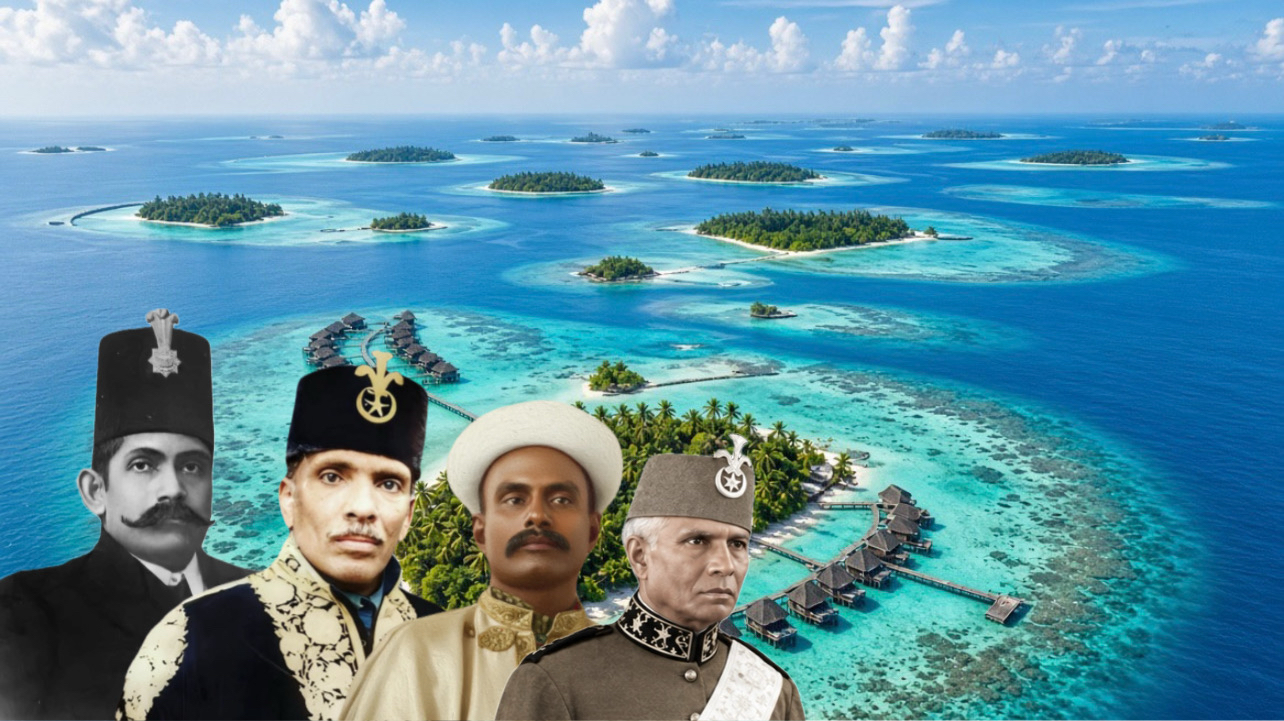
The title was borne by generations of Maldivian monarchs throughout the Islamic sultanate.
From Sultan Muhammad al-Adil (formerly King Dhovemi) the first Muslim ruler after the country’s conversion to later rulers including monarchs of the Theemuge, Hilaalee, Utheemu, Dhiyamigili, Isdhoo and Huraa dynasties, the designation remained part of the sovereign’s formal style. Even in the twentieth century, rulers such as Abdul Majeed Didi officially carried the title.
The Maldives under the Lords of the Twelve Thousand Isles
The Maldives was one of the Indian Ocean’s most important maritime kingdoms.
Long before tourism, the islands prospered through seaborne trade linking East Africa, Arabia, India and Southeast Asia. Maldivian cowrie shells served as an international currency across much of Africa and Asia for centuries, while dried tuna, coconut products, ambergris and coir rope were valuable exports. Foreign merchants, including Arabs, Persians, Chinese and later Europeans, regularly visited the islands, making the Maldives a small but strategically important trading state despite its limited land area.
Governing such a dispersed nation required remarkable maritime administration. Each atoll maintained local leadership under the authority of the sultan in Malé, while royal vessels connected distant islands across one of the world’s largest coral archipelagos.
The end of an era
The centuries-old royal title survived colonial influence, constitutional reforms and changing dynasties, but the institution that gave it meaning gradually faded.
The Maldives became a British protectorate in 1887 while retaining its own monarchy. Constitutional reforms during the twentieth century reduced royal authority, and after independence in 1965, the monarch briefly adopted the title of King of the Maldives instead of Sultan. Just three years later, a national referendum abolished the monarchy altogether.
With the establishment of the Second Republic on 11 November 1968, the title “Lord of the Twelve Thousand Isles” disappeared from official use, bringing to an end one of the longest-running royal styles in South Asian and Indian Ocean history.
Today, the title survives as a reminder of the Maldives’ rich royal heritage, a time when the ruler of a small island nation proclaimed sovereignty over what medieval chroniclers described as the “Twelve Thousand Isles.”