

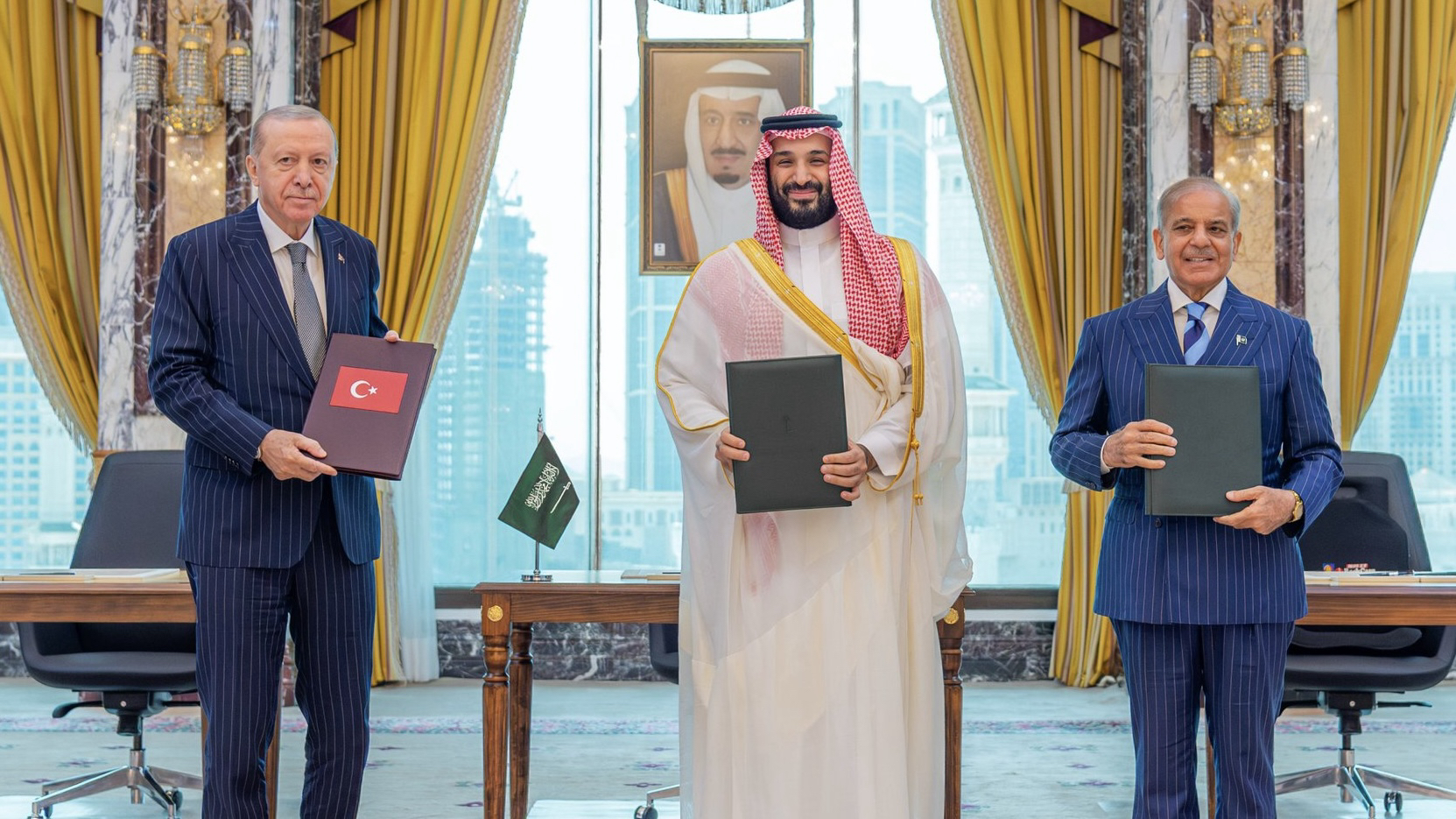
Saudi Arabia, Türkiye and Pakistan have signed a landmark Mecca Joint Defence Agreement, establishing a framework for closer military and security cooperation between the three countries. The agreement was signed in Makkah as tensions and security concerns continue to grow across the Middle East.
The agreement was signed by Saudi Crown Prince Mohammed bin Salman, Turkish President Recep Tayyip Erdoğan, and Pakistani Prime Minister Shehbaz Sharif. Under its central provision, an armed attack against any one of the three countries will be regarded as an attack against all three, establishing a principle of collective deterrence and mutual defence.
The agreement brings together three strategically important Muslim-majority countries with significant but complementary military capabilities. Türkiye is a NATO member with one of the alliance’s largest armed forces and a rapidly expanding defence industry. Pakistan is a nuclear-armed state with extensive military experience, while Saudi Arabia is one of the world’s major oil-producing countries and hosts Islam’s two holiest cities, Makkah and Madinah.
What does the agreement mean?
The pact is intended to strengthen collective deterrence, defence cooperation and military coordination among the three countries. Turkish officials have described the agreement as defensive in nature and stressed that it is not directed against any particular country.
President Erdoğan said the agreement is based on the principle of collective deterrence and will deepen cooperation in defence, including joint defence-industry projects and efforts to combat terrorism. He also said the agreement reaffirms the right of self-defence under Article 51 of the United Nations Charter.
The three governments have not publicly provided a detailed list of the military obligations that would automatically follow an attack on one of the members. In particular, the agreement does not publicly specify what type or scale of military response the other two countries would be required to provide.
This makes the pact different from simply announcing a permanent joint military command. Rather, its most significant publicly confirmed feature is the political commitment that an armed attack against one member will be treated as an attack against all three.
Why was the agreement signed now?
The agreement comes at a time of severe instability across the Middle East. The ongoing conflict involving Iran, Israel and the United States has increased security concerns throughout the Gulf, while attacks and disruptions affecting energy infrastructure and shipping have added pressure on regional governments.
For Saudi Arabia, the agreement provides another layer of security cooperation at a time when Riyadh is seeking to strengthen its own defence capabilities and diversify its strategic partnerships.
For Türkiye, the pact expands its security and defence relationships beyond its traditional NATO framework and creates opportunities for greater cooperation with two major regional powers.
For Pakistan, the agreement deepens its already longstanding military relationship with Saudi Arabia while giving Islamabad a stronger strategic role in Middle Eastern security.
A relationship that predates the new agreement
The trilateral agreement did not emerge suddenly. Saudi Arabia, Türkiye and Pakistan have already maintained defence cooperation for several years, including discussions on military technology, defence production, scientific research and the localisation of defence industries. Their trilateral defence committee had already held multiple meetings before the new agreement was signed.
Saudi Arabia and Pakistan also signed a separate Strategic Mutual Defense Agreement in September 2025, under which aggression against either country would be considered aggression against both. The new Makkah agreement therefore builds upon an already-established Saudi-Pakistani security relationship while bringing Türkiye into a broader trilateral framework.
Pakistan has already demonstrated military cooperation with Saudi Arabia under the earlier agreement. In April 2026, Pakistani fighter and support aircraft arrived at King Abdulaziz Air Base in Saudi Arabia as part of efforts to strengthen coordination, operational readiness and joint defence capabilities.
Is this a “Muslim NATO”?
Despite comparisons being made by observers, the three governments have not described the agreement as a Muslim NATO or a new military bloc.
Türkiye has explicitly said the agreement is defensive, does not target a specific country, and does not replace the countries’ existing bilateral or multilateral defence arrangements. Erdoğan also said that the agreement is open to other countries seeking peace, prosperity and stability in the region.
The agreement also does not publicly establish a unified military command or specify automatic troop deployments in the event of an attack. Its practical military implications will therefore depend heavily on how the three countries implement the agreement in the future.
A significant strategic development
Nevertheless, the agreement represents a major development in regional security. It combines Saudi Arabia’s economic and strategic importance, Türkiye’s large conventional military and defence industry, and Pakistan’s extensive military capabilities and nuclear deterrent within a single mutual-defence framework.
The timing is particularly significant. With the Middle East experiencing one of its most serious periods of instability in decades, Riyadh, Ankara and Islamabad are signalling that they intend to strengthen their ability to deter and respond to threats through closer cooperation.
The full military significance of the Makkah Joint Defence Agreement, however, will depend on its implementation—and particularly on how the three governments respond if one of them actually comes under armed attack.